Loading…
ChapterBrief · Manhwa
Manhwa Like Your Lie in April: 5 Picks That Deliver
Five manhwa like Your Lie in April sorted by emotional quality. Grief, art as emotional language, terminal romance, and coming-of-age through art.
13 min readBy Yuna Park

Readers searching for manhwa like Your Lie in April are usually honest about what they're doing: they know the source is Japanese, and they want the emotional register in Korean webtoon form.
TL;DR: Manhwa like Your Lie in April: 5 picks sorted by which emotional quality you're chasing, not padded to fill a list. Nothing in manhwa replicates the full combination of grief as narrative engine, terminal illness, and music as emotional medium. Closest for emotional interiority: Yumi's Cells. The internal world is the story.
Your Lie in April (Shigatsu wa Kimi no Uso) is a Japanese manga, not manhwa. It ran in Monthly Shōnen Magazine from 2011 to 2015, the anime adaptation aired in 2014, and it sits in a specific emotional register that manhwa has never directly replicated: classical music as emotional language, terminal illness revealed gradually rather than announced upfront, grief not as backstory but as the engine running the whole story. Readers searching for manhwa like Your Lie in April are chasing emotional qualities rather than a format match, and that's fine. But pretending any Korean webtoon delivers the identical experience would be doing you a disservice.
The honest version of this list is shorter than most "manhwa like YLiA" articles you'll find. I'm not recommending six manhwa because six is a round number. I'm recommending these six because each one genuinely covers one of the emotional territories YLiA stakes out, and I'm being clear about which territory each covers. If you came for the terminal illness pacing specifically, I'll tell you that directly rather than burying it. If you came for the grief, same. The list below gives you the search term and the honest match.
What you can find are manhwa that address individual aspects of what made YLiA hit the way it did. The recommendations below are sorted by which emotional quality drew you to the series in the first place.
Overview
Your Lie in April (Japanese: Shigatsu wa Kimi no Uso) is a Japanese manga by Naoshi Arakawa, serialized in Kodansha's Monthly Shonen Magazine from 2011 to 2015 and collected into 11 volumes. An anime adaptation by A-1 Pictures aired from October 2014 to March 2015 across 22 episodes. The series follows Kousei Arima, a piano prodigy who loses the ability to hear his own playing after his mother's death and has not performed in two years. He meets Kaori Miyazono, a violinist who performs freely and emotionally in ways that challenge every assumption his formal training built. Their relationship and her gradually revealed illness form the narrative spine of the series.
What makes Your Lie in April distinctive is the role music plays structurally. Classical performance is not backdrop or metaphor: it is the primary medium through which the characters communicate what they cannot say in conversation. Kousei's recovery is measured in recitals, not in emotional declarations. The terminal illness is paced carefully, present as a background detail long before it is named, so that the reveal reframes everything the reader already thought they understood. The series sits in a specific intersection: grief as narrative engine, art as emotional language, and coming-of-age measured in performances rather than victories. That combination is what searches for "manhwa like Your Lie in April" are chasing, and it is a combination Korean webtoon has not directly replicated in a single series.
Key takeaways
- Manhwa like Your Lie in April: 5 picks sorted by which emotional quality you're chasing, not padded to fill a list
- Nothing in manhwa replicates the full combination of grief as narrative engine, terminal illness, and music as emotional medium
- Closest for emotional interiority: Yumi's Cells. The internal world is the story.
- Closest for complex relationships shadowed by hidden pain: Cheese in the Trap
- Best for the terminal romance angle: Orange Marmalade
- Best for raw grief: The Horizon, short, brutal, completed
- Coming-of-age through performance and being seen: True Beauty (completed, WEBTOON)
- All six are worth finishing; none will break your heart the exact way YLiA did
manhwa like Your Lie in April: what your lie in april actually delivers
Advertisement
Before the recommendations, it's worth naming exactly what YLiA is doing. Four specific elements:
Grief as the central engine, not the backstory. Kousei's inability to hear his own music after his mother's death isn't setup: it's the story. Every relationship and every performance exists in relation to that wound. The grief doesn't get resolved and then give way to the actual plot. It is the plot.
Music as the only available language. Kaori communicates things to Kousei through performance that she cannot say directly. He registers things during her playing that he can't process in conversation. The art form does narrative work that dialogue cannot. This is unusual in any medium, and manhwa (a visual format without sound) faces an inherent challenge reproducing it.
A terminal illness that's gradual, not announced. Kaori's illness doesn't arrive as an opening premise. It creeps into the background of scenes, becomes harder to explain away, and finally resolves in a way that reframes everything before it. The pacing of that reveal is precise.
Coming-of-age through art, not power. Kousei's growth is measured in performances, not victories. He doesn't become stronger: he becomes more present. That's a specific kind of protagonist development that most manhwa doesn't attempt.
Our master manhwa reading list covers the top 30 titles across every genre for 2026.
Best Manhwa to Read in 2026 →

For the grief and the hidden weight at the center
Cheese in the Trap (WEBTOON, Naver Webtoon, completed) is the most emotionally serious manhwa about a relationship being shaped by something one person is carrying that the other can't fully see. Hong Seol and Yoo Jung are a couple: he is attentive, charming, and very slightly off in ways she can't identify. What she's sensing is real, and the series earns its complexity. There's no music and no terminal illness. But the emotional dynamic of circling around something that can't be named directly, the way relationships carry damage forward even when both people are trying: Cheese in the Trap does that with more psychological precision than almost any manhwa I've read. At 301 chapters (completed), it's a full story that doesn't take shortcuts. Full guide to romance manhwa has it listed as an anchor recommendation for a reason.
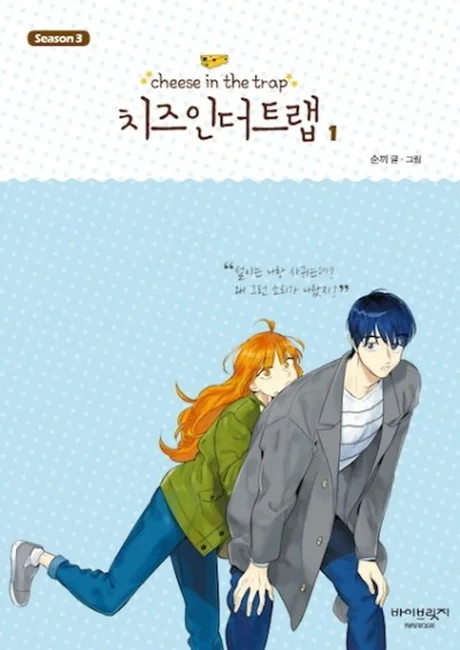 Cheese in the Trap cover art.
The honest caveat: Cheese in the Trap is more psychologically realistic and less romantically devastating than YLiA. It won't make you cry in the same register. It'll make you think. Some readers bounce off the first 30 chapters because Hong Seol's internal narration is slow to develop; the series earns patience.
Orange Marmalade (LINE Webtoon, completed) is structurally closer to the YLiA emotional pattern: a relationship shadowed by something one person is concealing, a reveal that reframes the early sections, an ending that doesn't arrive where you were hoping. Baek Ma-ri is a vampire living in a world where vampires exist but are stigmatized; she's spent her life learning not to be visible. Jung Jae-min falls for someone she has trained herself to hide. The supernatural premise is light: it functions almost entirely as metaphor for being different and having to manage how much of yourself other people can safely know. The romance is slow-burn and the emotional weight is genuine. Completed status matters here: you're not signing up for ongoing heartbreak that might never resolve. Best completed manhwa if you want more series with full story arcs.
For the coming-of-age through art and being seen
True Beauty (WEBTOON, completed at 223 episodes) is about Lim Jukyung, who becomes skilled at makeup and constructs an alternate public identity: someone beautiful, effortlessly social, unafraid. Two people see through the performance, for different reasons, and the romantic triangle that results is less about who she ends up with and more about which version of herself she chooses to live as. The "art" here is cosmetics and self-presentation rather than classical music, but the underlying question (can someone love who you actually are, not who you've learned to perform) is identical. What YLiA's music scenes do through sound, True Beauty does through the gap between the public and private self. And unlike a lot of manhwa romance, it earns its ending. True Beauty reading guide for full series context if you're approaching it cold.
 True Beauty cover art.
The difference: True Beauty is warmer and less devastating. The grief is identity-level rather than mortality-level. If you want the emotional themes without the emotional damage, this is the pick.
Yumi's Cells (Kakao Webtoon/Tapas, completed) is the strongest recommendation on this list for anyone who connected with YLiA's approach to interiority: showing what characters feel rather than what they say. The series follows ordinary office worker Kim Yu-mi through relationships, but the actual narrative happens inside her head, where anthropomorphized brain cells argue, despair, celebrate, and process damage that the external scenes only hint at. The grief in Yumi's Cells is the quiet, accumulative kind: the slow loss of who you were before someone hurt you, the process of rebuilding after. It's funnier than YLiA and less structurally dramatic. But it's genuinely about emotional experience as its subject, not as backdrop for plot. Slice-of-life manhwa recommendations if Yumi's Cells sounds like the right register.
Yumi's Cells is the honest answer to "what manhwa takes emotional interiority as seriously as YLiA does." It's just doing it through a different formal device.
One worth noting specifically: the grief in Yumi's Cells is not the acute, devastation-in-the-final-episode kind that YLiA delivers. It's the long kind: months of low-level heartache after a relationship ends badly, the slow recalibration of who you are when someone who shaped you is gone. It landed differently for me than YLiA did, but it landed. Best manhwa for couples has it in the romance picks section if you want to read what others pair it with.
For the grief without the music
The Horizon (completed, 3 volumes) is the recommendation I make when readers specifically say they want the grief, the mortality, the sense that the world isn't going to be okay. Two children (a boy, a girl) meet in a post-apocalyptic world that the series never explains. They walk. People they encounter don't survive. The art is spare and the panel composition does the emotional work that the sparse text leaves undone. The Horizon runs about 250 pages total. It's complete. It is not comforting. But it takes grief seriously as subject matter in a way that most manhwa (which treats loss as a plot event) doesn't. No music, no romance, no school setting. Just what it costs to keep going when the world has already ended. Dark manhwa recommendations for further reading if this register is what you're after.
The honest caveat: The Horizon shares YLiA's emotional weight but almost nothing else. There's no coming-of-age through art, no romance, no music. Recommend it specifically for readers who said the grief was the part that stayed with them. If you bounced off it after 50 pages (which some people do, because it withholds explanation entirely), try coming back after the other five picks on this list. It lands differently when you've spent time with series that handle grief more gently first.
Our best romance manhwa list covers tearjerker and music-themed romance stories for fans of emotional narratives.
Best Romance Manhwa 2026 →
manhwa like Your Lie in April: the honest gap. What manhwa can't give you
Advertisement
Classical music as emotional medium is genuinely absent from manhwa. The webtoon format (vertical scroll, static panels, no sound) can't do what YLiA's performance sequences do. Music in manga/anime can carry a scene by itself; a panel of someone playing violin can't. The manhwa that come closest tend to substitute a different performance register: True Beauty does performance-of-self, Yumi's Cells does interior emotional theater. Neither is the same.
The terminal illness pacing is also unusual. YLiA reveals Kaori's illness slowly and without announcement. Most manhwa that use illness as a narrative element announce it early or hold it as a twist. The patient, gradual reveal (where the reader understands what's happening before the protagonist does) is rarer.
What manhwa does well: emotionally complex relationships (Cheese in the Trap), coming-of-age through identity rather than art (True Beauty), and the kind of interior emotional life that YLiA renders through music (Yumi's Cells). None of them are replacements. They're adjacent experiences worth having.
The honest ranking if you want the closest overall: Yumi's Cells first for emotional interiority, Cheese in the Trap second for relationship complexity, Orange Marmalade third for the slow-burn hidden-weight romance. The Horizon is a separate category: it's not a romance, it's grief as a complete story. True Beauty is the warmest of the six and the safest place to start if you want guaranteed emotional payoff without the devastation risk. For readers who want to stay on WEBTOON specifically, best manhwa on WEBTOON 2026 has more picks filtered by platform.
Frequently Asked Questions
Is there a manhwa that feels like Your Lie in April?
Nothing in manhwa replicates the full package: terminal illness romance with classical music as the emotional medium is a specific combination that YLiA executes better than anything in the Korean comics space. Yumi's Cells is the closest for emotional interiority. Cheese in the Trap is the closest for emotionally complex relationships where someone's hidden pain drives everything. If you want the grief and coming-of-age themes without the music, The Horizon is worth reading.
Is Your Lie in April a manhwa or manga?
Your Lie in April (Shigatsu wa Kimi no Uso) is a Japanese manga, not manhwa. It was serialized in Monthly Shōnen Magazine from 2011 to 2015 and adapted into anime by A-1 Pictures in 2014. Manhwa is Korean. The search for "manhwa like Your Lie in April" is a real one: readers want the emotional qualities in Korean webtoon format, but it's worth being clear that the source is Japanese.
What is it about Your Lie in April that's so hard to replicate?
The combination of three specific things: grief as the central narrative engine (not background color), a character who is terminally ill and conceals it, and music functioning as the actual language through which the characters communicate what they can't say out loud. Manhwa has plenty of grief stories and plenty of romance, but the classical music medium is unusual and the terminal illness is revealed gradually rather than announced as a premise.
Is Cheese in the Trap similar to Your Lie in April?
In emotional register and complexity, yes: they both involve protagonists whose relationship is shaped by someone carrying an invisible weight the other can't fully see. Cheese in the Trap is less devastating and more psychologically layered in a realistic contemporary way. There's no terminal illness and no music, but the emotional interiority is serious and the character work is exceptional. It's a good next read, not a direct replacement.
What manhwa deals with grief the way Your Lie in April does?
The Horizon is the most direct answer: grief, loss, and children confronting a world that ended are the whole story, not incidental. It's short (3 volumes), brutal, and doesn't give you the romantic throughline YLiA has. For grief filtered through a relationship, Yumi's Cells shows a character rebuilding after emotional damage in ways that are quiet and specific rather than dramatic.
Are these manhwa free to read?
True Beauty and Cheese in the Trap are on WEBTOON with free chapters available; older completed episodes are fully unlocked. Yumi's Cells is on Kakao Webtoon and Tapas with partial free access. Orange Marmalade is completed and available on LINE Webtoon's back catalog. The Horizon is available through Drawn & Quarterly in print, and digitally through Comixology.
Does Orange Marmalade have the same emotional tone as Your Lie in April?
The emotional weight is similar: both are about a relationship shadowed by something one person is hiding, and both end in a way that doesn't give you the comfortable landing you keep hoping for. Orange Marmalade adds a supernatural premise (the female lead is a vampire) that functions as a metaphor for being different and having to conceal it. The romance is quieter and slower-burn. It's completed, which makes it a safer emotional investment than ongoing series.
Related Reading
- Best Manhwa to Read in 2026 →
- Full guide to romance manhwa
- Best completed manhwa
- True Beauty reading guide
- Slice-of-life manhwa recommendations
References
- True Beauty on WEBTOON: full series, completed at 223 episodes
- Cheese in the Trap on WEBTOON: completed, 301 chapters
- Yumi's Cells on Kakao Webtoon / Tapas: completed series
- Best romance manhwa recommendations
- Best completed manhwa to read in 2026
- Slice-of-life manhwa picks
- Manhwa like True Beauty: extended reading guide
- Dark and horror manhwa recommendations
- Best manhwa for couples: romance picks
- Best manhwa on WEBTOON 2026
About the author

Anime and manhwa writer covering seasonal releases and ongoing webtoons since 2018. Seoul-born, Melbourne-based. Writes the way she reads — fast and direct.
- Covering anime and manhwa since 2018
- 400+ series completed across anime and manhwa
- Seasonal anime tracker for 6 years running
- Romance and fantasy specialist with deep genre knowledge

Disclaimer
This article is published for informational and entertainment purposes. It does not constitute professional financial, legal, or technical advice. Series availability, platform access, translation status, and chapter counts change. Verify critical details (pricing, regional availability, official translation status) with publishers and platforms. Affiliate links, where present, help support our editorial work and are labelled in our affiliate disclosure.
Comments
Loading comments…