Loading…

ChapterBrief · Manhwa
Manhwa Like Revenge of the Baskerville Bloodhound: 6 Picks
Manhwa like Revenge of the Baskerville Bloodhound: 6 picks for readers who want the patient long-game revenge, hidden power, and noble hierarchy.

Manhwa like Revenge of the Baskerville Bloodhound: six picks for readers who want the patience, the political texture, and the cold composure of a man playing a game no one else knows they're in.
TL;DR: Manhwa like Revenge of the Baskerville Bloodhound: The Beginning After the End (ongoing, closest regression match with adult patience in young body), Return of Mount Hua Sect (most structurally similar patience-within-hostile-sect premise), A Returner's Magic Should Be Special (completed, foreknowledge regression), Chronicles of the Heavenly Demon (completed, infiltration within hostile organization), Solo Leveling (completed, best finished underestimated-protagonist manhwa), and Best System Fantasy Manhwa for the full genre map.
Baskerville Bloodhound works because Vikir Van Baskerville never rushes. He's a war hero who got betrayed by the family he served, regressed to his teenage years inside that same family's training compound, and is now rebuilding his position one carefully chosen action at a time. Finding another series with that exact structure isn't easy, but the recommendations below target the elements that drive the series: the patience, the hidden-strength premise, the dark political hierarchy, and the satisfying gap between who Vikir appears to be and who he actually is.
One note before reading further: the recommendations below match the Season 1 version of Baskerville, the gothic regression within the assassin family that drives the series' reputation. The later arcs introduce an academy and a tower-climbing system that shift the tone; community opinion on those sections is mixed. If you're recommending based on what Baskerville does at its best, the series below are the right comparisons.
Manhwa like Revenge of the Baskerville Bloodhound: quick answer
The best matches in order:
- The Beginning After the End: ongoing (Season 7 as of 2026), adult king regressed to child, patient power build in fantasy setting
- Return of Mount Hua Sect: ongoing, most structurally similar patience-within-hostile-organization premise
- A Returner's Magic Should Be Special: completed 268 chapters, foreknowledge regression, academy-to-battle structure
- Chronicles of the Heavenly Demon: completed 252 chapters, infiltration premise, hiding true power inside hostile sect
- Solo Leveling: completed 179 chapters, underestimated protagonist with growing hidden ability, best finished manhwa for this reader profile
- Best System Fantasy Manhwa: full genre list if none of the above land
What they share with Baskerville Bloodhound: protagonists whose apparent status dramatically underrepresents their actual capability, situations where revealing the full truth too early would destroy the strategy, and enough chapter volume to build genuine investment. What differs is the setting, whether the organization is family or sect, and how long the patient arc holds before the confrontation arrives.
 The Beginning After the End cover art.
1. The Beginning After the End
Best for: Readers who want the most developed regression world, even without a finished ending
The Beginning After the End follows Arthur Leywin, a king who dies and reincarnates as an infant in a fantasy world. He carries all of his previous life's combat experience, political wisdom, and strategic patience into a childhood he knows he'll have to survive before he can act on any of it.
The parallel to Baskerville is the posture. Both protagonists have adult mastery of violence and statecraft operating inside a youthful body inside a world that doesn't know what they're dealing with. Both series build their appeal from the gap between the protagonist's apparent position and their actual capability. Arthur's patience in building relationships and power before the story demands it from him reads as mature strategy in the same way Vikir's does.
The fantasy world-building in TBATE is more expansive than Baskerville's dark European setting, and the tone shifts more sharply across arcs. But for readers drawn to the regression premise at its most developed, TBATE is the closest available match.
Arc structure and when TBATE's pacing shifts gears:
The Beginning After the End Reading Guide
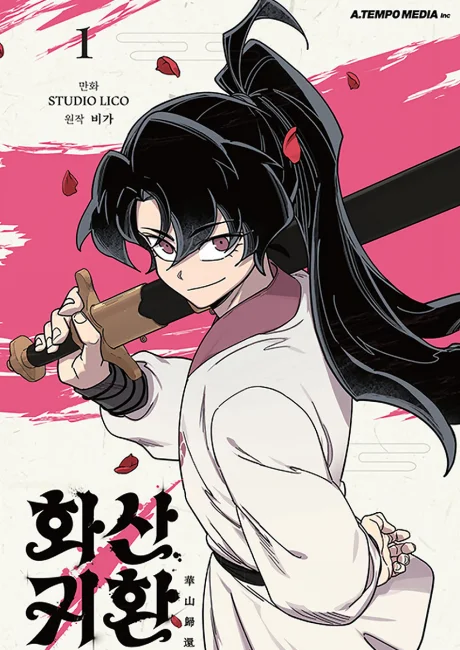 Return of Mount Hua Sect cover art.
2. Return of Mount Hua Sect
Advertisement
Best for: Readers who want the most structurally similar patience-within-hostile-organization premise
Return of Mount Hua Sect is the closest structural match to Baskerville Bloodhound. Cheonma, a great master of the Mount Hua Sect, dies and regresses to his youth inside the very sect that he'll have to rebuild from its collapsed state. He's the strongest person alive, hiding inside the weakest organizational structure, playing a game that spans decades.
The architecture of the premise is nearly identical to Baskerville. Both protagonists regressed into an organization that wronged them or needs them in ways no one understands yet. Both operate through patience and composure rather than immediate confrontation. Both series understand that the waiting is the point, not an obstacle to the action.
Where Baskerville is dark European fantasy with court intrigue, Return of Mount Hua Sect is murim cultivation with sect politics. The settings are completely different. The structural logic is the same: a protagonist with full adult mastery playing a multi-year game inside an organization that has no idea they're doing it.
 A Returner's Magic Should Be Special cover art.
3. A Returner's Magic Should Be Special
Best for: Readers who want the foreknowledge regression premise in a completed package
A Returner's Magic Should Be Special is completed at 268 chapters. Desir Arman returns from a future where humanity nearly went extinct to the past, carrying his knowledge of what's coming. He enrolls in a magic academy and uses that foreknowledge to prepare the people around him for the catastrophe that only he knows is coming.
The foreknowledge structure is what connects it to Baskerville. Both protagonists know something critical about the future that gives them an impossible advantage over everyone around them. Both use that advantage carefully rather than immediately. Desir's choice to work through an academy rather than simply preventing specific events reads as strategic patience in the same register as Vikir's choice to rebuild his position from within the Baskerville training compound.
At 268 completed chapters, A Returner's Magic Should Be Special is the strongest finished alternative for readers who want the foreknowledge premise with a real ending. The tone is more academic and less dark than Baskerville, but the structural satisfaction of watching a protagonist who knows more than anyone else play out a long-game plan is present in full.
What makes the foreknowledge premise work long-term in regression manhwa:
A Returner's Magic Should Be Special Review
 Chronicles of the Heavenly Demon cover art.
4. Chronicles of the Heavenly Demon
Best for: Readers who want the infiltration premise in a completed package
Chronicles of the Heavenly Demon uses an infiltration premise that maps directly to the Baskerville structure. Un-Seong, whose master was killed by the Heavenly Demon Sect, masters their demonic arts while hiding inside the sect that killed his master. He's the most dangerous person in the organization, playing by its rules while building toward a confrontation that will take years.
The structural parallel is the infiltration itself. Where Baskerville has Vikir hiding his war-veteran capability inside the Baskerville family's training structure, COTHD has Un-Seong hiding his demonic arts mastery inside the Heavenly Demon Sect's hierarchy. Both series are interested in what the long game looks like when played by someone with complete mastery in an environment designed to destroy them.
At 252 completed chapters, COTHD delivers a full story with a real ending. Readers who want to understand the dark-fantasy infiltration premise in a finished form should read it before or after Baskerville.
 Solo Leveling cover art.
5. Solo Leveling
Best for: Readers who want the best completed underestimated-protagonist manhwa
Solo Leveling is the reference point for the underestimated-protagonist premise in the modern tower genre. Sung Jin-Woo starts as the weakest hunter in a world of dungeon fighters and gains a unique system that lets him grow while everyone else's abilities are fixed at their awakening level. The series is built on the satisfaction of watching someone who was dismissed as weak become something no one can account for.
The parallel to Baskerville is the posture of concealment. Vikir hides his true capability by design. Sung Jin-Woo's early chapters build the same gap between apparent status and actual trajectory. Both series understand that the moment of revelation is more satisfying the longer the concealment holds.
Solo Leveling doesn't have Baskerville's patience or political texture, but it's the best completed manhwa for the reader profile that Baskerville serves. At 179 completed chapters with exceptional art, it's the series that Baskerville readers who want a finished story should read if they haven't.
6. Best System Fantasy Manhwa
For readers who've already worked through several of the above and want a wider map of the regression and hidden-power genre, the Best System Fantasy Manhwa list covers the full category: regression manhwa, awakening manhwa, tower manhwa, and the overlap zones between them.
Baskerville Bloodhound sits at the intersection of regression and dark-fantasy political intrigue. The broader list helps readers identify which of those elements drove their engagement most before committing to the next series.
What to look for when picking
Advertisement
If the patience specifically was the draw: Return of Mount Hua Sect is the best ongoing match for the long-game patience structure. It's the closest to Baskerville's specific rhythm.
If a completed arc was the draw: A Returner's Magic Should Be Special (268 ch) and Chronicles of the Heavenly Demon (252 ch) are both finished with real endings.
If the infiltration within a hostile organization was the draw: Chronicles of the Heavenly Demon is the most developed take on that premise in a completed package.
If the adult-in-young-body regression was the draw: The Beginning After the End is the fullest world with the most developed regression structure.
If the underestimated-protagonist arc was the draw: Solo Leveling is the best completed version of that satisfaction loop.
Frequently Asked Questions
What manhwa is most similar to Revenge of the Baskerville Bloodhound?
Return of Mount Hua Sect is the closest structural match: regression places an adult with mastery inside a hostile organization, and both series build their arc through patience rather than early confrontation.
Is Revenge of the Baskerville Bloodhound completed?
No. The manhwa is ongoing on Naver Webtoon with regular releases. The source web novel is complete for readers who want to read ahead.
What makes Baskerville Bloodhound different from other regression manhwa?
Restraint. The protagonist has the discipline to not reveal what he's capable of even when he could. Most regression manhwa accelerate to the power reveal early. Baskerville delays it because the waiting is the point.
Are there completed manhwa like Baskerville Bloodhound?
A Returner's Magic Should Be Special (268 ch) and Chronicles of the Heavenly Demon (252 ch) are the strongest finished alternatives with foreknowledge and infiltration structures respectively.
What is the appeal of Revenge of the Baskerville Bloodhound?
Watching a protagonist play a multi-year game in an environment that doesn't know they're doing it. The gap between Vikir's apparent position and actual capability is the engine. Every moment another character underestimates him is satisfying because the reader knows what he's choosing not to show.
References
- Revenge of the Baskerville Bloodhound on Naver Webtoon. Original serialization platform; ongoing as of 2026.
- Return of Mount Hua Sect on WEBTOON. Closest structural match to Baskerville's patience premise.
- A Returner's Magic Should Be Special on Tapas. 268 chapters, completed; foreknowledge regression.
Related Reading
- Revenge of the Baskerville Bloodhound Review: The full 8.5/10 review with arc breakdown and what the patience structure delivers.
- The Beginning After the End Reading Guide: Arc structure for the closest regression match, with guidance on the pacing shift mid-series.
- Return of Mount Hua Sect Reading Guide: Arc breakdown for the most structurally similar ongoing series.
- Best Murim Manhwa 2026: Full murim list covering cultivation, sect politics, and revenge-driven manhwa.
- Best System Fantasy Manhwa: Complete genre map including regression, awakening, and hidden-power manhwa.
- Revenge of the Baskerville Bloodhound Reading Guide: Chapter breakdown and reading tips for Revenge of the Baskerville Bloodhound.
About the author

Senior Manhwa Critic & Analyst
Manhwa critic and former Korean-to-English webtoon translator with 8 years reading across 40+ genres. London-based. Tracks everything from power-progression to slice-of-life romance.
- 8 years reading manhwa across 40+ genres
- Former Korean-to-English webtoon translator
- 500+ manhwa titles completed
- Specializes in progression systems and power-scaling analysis




Disclaimer
This article is published for informational and entertainment purposes. It does not constitute professional financial, legal, or technical advice. Series availability, platform access, translation status, and chapter counts change. Verify critical details (pricing, regional availability, official translation status) with publishers and platforms. Affiliate links, where present, help support our editorial work and are labelled in our affiliate disclosure.
Comments
Loading comments…