
Solo Leveling review conversations tend to split in two directions: either the respondent treats it as a generation-defining work with no real flaws, or they dismiss it as pretty but shallow.
TL;DR: Solo Leveling review: 8.5/10. The completed 200-numbered-chapter manhwa delivers exceptional art and clean power progression, while its story stays thinner than the spectacle suggests. Read all 21 canonical side stories after chapter 179.
Neither take is especially useful if you're deciding whether to read 200 numbered chapters.
The honest version: the art is as good as advertised. The wish-fulfillment is extremely satisfying. And the story is thinner than its fanbase tends to admit. Not broken, not bad, but it doesn't match the weight of the artwork carrying it. That's the essential Solo Leveling review in two sentences. Everything below is the longer case for both sides.
This review covers the manhwa only. For A-1 Pictures' TV adaptation, animation quality, voice cast, and the Sawano score, see our Solo Leveling anime review.
Key Takeaways
- Rating: 8.5/10. Art and power system are exceptional; narrative depth is not
- 200 numbered chapters completed: 179 main story + 21 canonical side stories. Do not stop at 179
- Series peak: the Ant Island arc, roughly chapters 98-120
- DUBU (Jang Sung-rak) passed away in July 2022 at age 40. The completed manhwa is his most visible work
- Two anime seasons on Crunchyroll cover chapters 1-110. From 111 onward, it's manhwa-only
- Ranks #1 on our best action manhwa 2026 list for art and power progression, not for plot
Solo Leveling Review: Overview
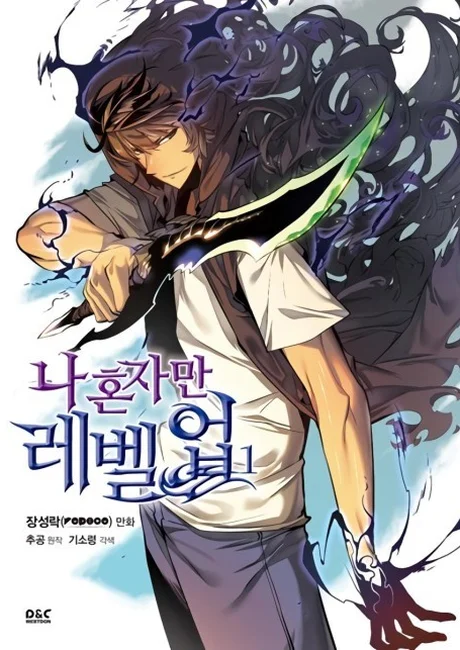 Solo Leveling.
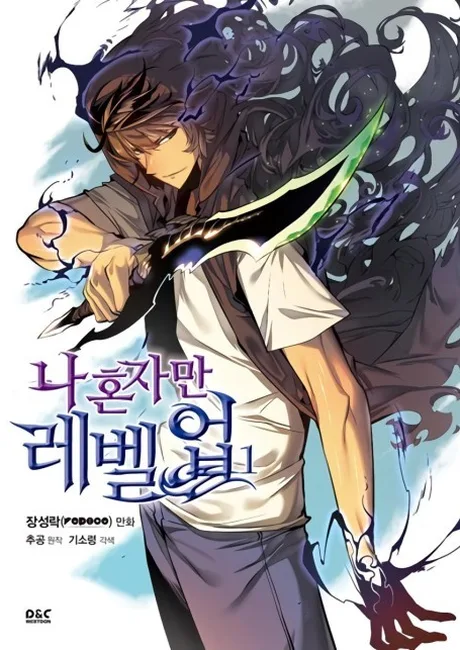 Official cover art for the Solo Leveling manhwa by DUBU (Jang Sung-rak). Source: AniList.
Solo Leveling started as a web novel on Munpia in February 2014, written by Chu-Gong. The manhwa adaptation launched on KakaoPage on March 4, 2018, illustrated by Jang Sung-rak (DUBU). The main story concluded on December 29, 2021. The 21 side story chapters that follow are canonical and the actual ending: they resolve the romance arc and introduce Jin-Woo's son, Sung Suho. The series is published in English by Yen Press (print) and available digitally on Tappytoon.
Sung Jin-Woo is classified as the weakest hunter in a world where dungeon-clearing professionals rank E through S. After surviving a double dungeon that should have killed him, he receives access to a personal leveling system no other hunter can see. From E-rank to something beyond classification, over 179 chapters.
That's the setup. The execution is where opinions diverge.
What it does right
Advertisement
The art is the answer to most criticism. DUBU's illustration is not "good for manhwa." It holds up against any action comic in the world. The fight choreography is deliberately composed: each sequence has a visual grammar that makes the action readable at speed and rewarding on a slower look. The shadow army aesthetic (black armor, hollow eyes, spectral silhouettes) is immediately recognizable and was referenced (generously speaking) by roughly twenty manhwa that launched after it.
The power progression is designed for satisfaction. Jin-Woo acquires skills incrementally, the shadow extraction mechanic gives every significant defeat a consolation prize that compounds later, and the army-building creates a compounding sense of investment over the full run. By the time the Ant King fight resolves around chapter 120, the reader has watched 30 hours of asset accumulation pay off in one sequence. That's not an accident.
The dungeon arcs are where the series operates cleanest. The structure is simple: Jin-Woo enters a dungeon, something goes wrong, he adapts. But the execution keeps varying the variables enough that it doesn't feel repetitive until very late in the run. The Ant Island arc (chapters 98-120) is the most frequently cited peak among long-time readers, and it's where the art and power system align most precisely.
Need the chapter-by-chapter and anime breakdown before starting?
Solo Leveling reading order →
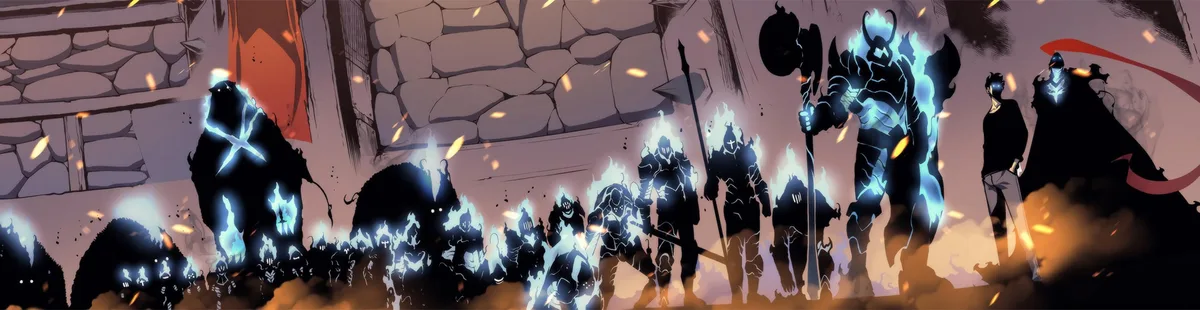 Solo Leveling promotional banner. The shadow army aesthetic, designed by DUBU, became one of the most imitated visual motifs in action manhwa. Source: AniList.
Art & Story
DUBU's illustration is the most discussed element of Solo Leveling for good reason. The fight choreography is deliberately composed: action sequences are readable at speed and hold up under slower examination. The shadow army aesthetic (black armor, hollow eyes, spectral silhouettes) is immediately distinctive and was referenced by roughly twenty manhwa that launched in its wake. Dungeon environments use high contrast and spatial depth that make fights feel physically situated rather than floating in undefined space.
The visual storytelling is strongest in the Ant Island arc. DUBU uses scale effectively in this sequence: the Ant King is rendered as genuinely massive rather than just labeled so, and Jin-Woo's approach draws on 100 chapters of accumulated shadow army assets paying out in a single extended sequence. It's the most visible demonstration that the art and the power system were designed to support each other.
The narrative structure is a clean, single-protagonist wish-fulfillment. Sung Jin-Woo moves from the weakest hunter classification to something beyond any existing rank across 179 chapters. The story does not invest heavily in the supporting cast's interior lives; most secondary characters exist to register Jin-Woo's growth rather than develop alongside it. That's a deliberate trade: the series concentrates emotional weight on Jin-Woo's progression and uses the shadow army as its primary storytelling device for demonstrating accumulated power.
Where the story finds more texture is in the side stories (chapters 180-200), which shift register entirely into domestic and personal territory. The transition feels earned because the preceding 179 chapters spent enough time on Jin-Woo's specific emotional situation that the quieter resolution lands. The side stories are the story's actual ending, and the tonal contrast is intentional.
Where it falls short
The supporting cast is the clearest limit. With the exception of Cha Hae-In (whose dynamic with Jin-Woo provides most of the emotional texture in the series), nearly every other character exists to react to Jin-Woo's power. Thomas Andre has a memorable entrance and then becomes irrelevant. Go Gunhee serves a narrative function but is thin as a character. The Korean hunter association regulars are interchangeable by the midpoint.
This isn't unusual for a shonen-adjacent wish-fulfillment. But it limits what the series can do in its later chapters. When the Monarchs conflict scales up to global stakes after chapter 130, there's no supporting cast capable of carrying emotional weight through the bigger story. Jin-Woo has to carry everything, and he's cool but not complex enough to do that job alone.
The Monarchs arc (chapters 130-179) is the weakest third of the run. The dungeon arcs worked because the rules were clear and the stakes were personal. The Monarchs conflict brings in mythology, world-ending threats, and cosmic lore that never quite connects to what made the first 120 chapters work. Pacing is uneven: some chapters rush through setups that deserved more room, others stall in ways the dungeon arcs didn't.
The finale lands, but without the emotional force I expected after 179 chapters. That payoff is in chapters 180-200.


The side stories are not optional
I had the obvious reaction reading chapters 180-200 without being warned what was coming. Quieter than anything in the main run, domestic in a way that would have felt jarring if it hadn't been earned.
The side stories resolve what the main story doesn't: Jin-Woo adjusting to a world without the war, his relationship with Cha Hae-In finding an actual landing place, and a time-skip introducing the next generation. If you have any feelings about these characters by chapter 179 (and you probably do), the side stories are where those feelings get paid off.
I dropped out at chapter 179 the first time I read it, treating it as the end. Came back a year later when someone told me I was missing the actual ending. They were right. Read them immediately after chapter 179.
That next generation the time-skip introduces gets its own series. Solo Leveling: Ragnarok follows Jin-Woo's son Suho, and our review covers the obvious question (no, it is not cancelled, just on hiatus) plus whether the sequel escapes the original's shadow. Our Solo Leveling: Ragnarok reading guide covers the arc breakdown for readers picking it up now.
Looking for other completed series with real endings?
Best Manhwa to Read in 2026 →
Solo Leveling Review Verdict
Advertisement
The Good
- DUBU's action art makes the dungeon fights immediately readable and visually memorable.
- The 179-chapter main story plus 21 side stories gives the manhwa a complete arc.
The Cons
- The supporting cast and plot remain thinner than the artwork.
- The power curve eventually reduces suspense once Jin-Woo outclasses most opponents.
Rating: 8.5/10
The art earns the hype. The power system is designed well. The dungeon arcs, especially Ant Island, are some of the most satisfying reading in action manhwa. Solo Leveling review verdict isn't complicated if you go in knowing what you're getting: a wish-fulfillment story with exceptional production, not a story with exceptional depth.
Fans who frame it as a complete narrative achievement are asking more from the story than it delivers. The supporting cast is limited. The Monarchs arc is the weakest third of a strong run. But a weak third act after two-thirds of consistently strong chapters is a different kind of problem from a bad series. The art holds up. The shadow army is satisfying. The side stories pay it off.
Start reading. When you reach the end of chapter 179, keep going.
For what to read once it's done, Manhwa Like Solo Leveling → has ten picks built around what makes the series work. If the system mechanic was the part you liked most, the Best System Fantasy Manhwa → ranked list puts Solo Leveling in context alongside series with more inventive mechanics.
For where Solo Leveling fits among the best gate-and-dungeon isekai manhwa, the best isekai manhwa list covers the full field.
Frequently Asked Questions
Is Solo Leveling worth reading in 2026?
Yes. The art and power system are genuinely exceptional, and the completed run (200 numbered chapters including side stories) lets you binge it in full. The main caveat: the story is thinner than the hype suggests. It's a wish-fulfillment story done extremely well, not a narrative achievement. What chapters does the Solo Leveling anime cover?
Season 1 (12 episodes, Jan-Mar 2024) covers approximately chapters 1-45. Season 2 'Arise from the Shadow' (13 episodes, Jan-Mar 2025) covers through roughly chapter 110. Both are on Crunchyroll. The remaining story (chapters 111-200) is only in the manhwa. Do I need to read the Solo Leveling side stories?
Yes. The 21 side stories (chapters 180-200) are the actual ending. Chapter 179 ends the main battle, but the side stories resolve Jin-Woo's arc with Cha Hae-In and introduce Sung Suho. Stopping at 179 is like leaving a film before the last scene. Is the Solo Leveling light novel worth reading after the manhwa?
If you want more of Jin-Woo's interior reasoning, especially the Monarch lore and his emotional state, yes. The novel covers the same events with significantly more inner monologue. Eight Yen Press volumes. It's the same story, not a separate one. Is Solo Leveling a good entry point for manhwa newcomers?
It's one of the most common entry points precisely because it's visually spectacular and easy to follow. The power system is clear from chapter one, the protagonist's goal is immediate, and the art does the heavy lifting. Starting here is a reasonable choice. How long is Solo Leveling?
179 main chapters plus 21 canonical side stories make 200 numbered chapters. AniList currently lists 201 chapters and Tapas lists 202 episodes; Tappytoon includes Episode 0 and labels the epilogue separately. At 20-30 chapters per session, that's 6-10 reading sessions, roughly 15-20 hours total for the complete run. Who is DUBU and why does the art matter in this Solo Leveling review?
DUBU is the pen name of Jang Sung-rak, the artist who drew Solo Leveling. His work here (fight choreography, shadow aesthetics, system UI design) is considered among the best in the format. DUBU passed away in July 2022 at age 40. The completed manhwa is his most visible legacy.
For series recommendations in the same genre, see Completed Manhwa Like Solo Leveling: 8 Series Worth Reading.
Related Reading
- Solo Leveling Reading Guide: Arc breakdown from E-rank tutorial through Monarch arc, with chapter turning points.
- Manhwa Like Solo Leveling: Seven picks for readers who want the dungeon-hunter power climb in different forms.
- SSS-Class Revival Hunter Review: The most mechanically distinct system fantasy alternative to Solo Leveling.
- Solo Leveling Season 3 Release Date: No Trailer, New Movie
- Solo Leveling: Beyond the System Anime Movie Explained: everything confirmed so far about the next Solo Leveling anime.
- Solo Leveling Characters: Every Hunter and Shadow Ranked: the full cast sorted by role, from Jin-Woo's inner circle to the named Shadow Army and the Monarchs.
- Solo Leveling Power System Explained: hunter ranks, why only Jin-Woo has a System, and the Rulers vs Monarchs divide.
- Solo Leveling Live Action K-Drama: what Netflix confirmed, what remains reported, and why there is no premiere date yet.
- Best Selling Manhwa of All Time: the commercial case, a New York Times number-one bestseller placement, a World Webtoon Awards Grand Prize, and a mobile game that passed $100 million in three months.


