
TL;DR: Manga omnibus vs volumes comes down to source range, handling, and shelf space. Single volumes are lighter and easier to buy gradually. Omnibus books reduce spine count but create heavier reading blocks. Deluxe editions add size or presentation. Compare the publisher's source-volume range, page count, trim, and extras before buying.
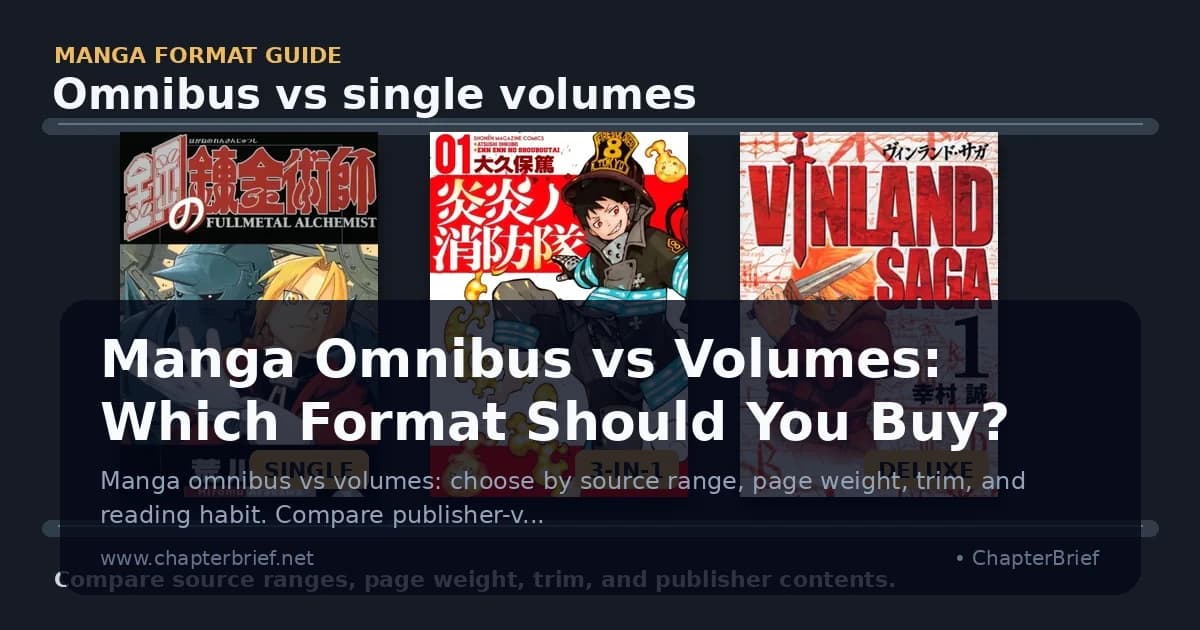
If you are deciding between one thick book and several familiar paperbacks, the word “omnibus” only answers part of the question. It tells you that multiple source volumes were combined. It does not tell you how heavy the finished book is, what trim it uses, whether the page block is comfortable, or how that edition fits beside the rest of your shelf.
This guide covers Japanese manga and official English print editions. It is separate from the site's manga collecting guide, which covers the wider shelf system, and from the best manga box sets guide, which focuses on boxed runs and included extras. If your collection is Korean manhwa, use the physical manhwa buying guide instead of assuming the same publisher formats apply.
Overview: manga omnibus vs volumes at a glance
Buy single volumes for flexibility and lighter handling, an omnibus for fewer books and a larger reading block, and a deluxe edition when the physical presentation matters. The publisher's edition page decides how many source volumes are inside, because “omnibus” is not a universal page count.
The terms below describe different decisions:
- Single volume: one collected volume in a standard line. It is easy to sample, replace, lend, or match with an existing run.
- 2-in-1 or 3-in-1 omnibus: two or three source volumes combined into one book. The result saves spine space but increases page weight.
- Deluxe edition: a premium line that may change trim, binding, paper, bonus material, or source-volume range. “Deluxe” is a presentation label, not a fixed number of chapters.
- Box set: a package of separate books and extras. It is not the same as an omnibus, even when the story contents overlap.
The most useful comparison is not “Which format is cheapest?” Prices and availability move, and this guide does not use a price from memory. Ask which book you will actually read, how much weight you want in your hands, and whether the named publisher record matches the collection you are building.
Key Takeaways: choose the format before the title
For most readers, single volumes are the safest first purchase because they let you test the story and the English edition without committing to a thick stack. Omnibus books make more sense when shelf space is tight or you want a long reading session. Deluxe editions earn their place when size, binding, or bonus content is part of the appeal.
- Check source-volume range first. A 3-in-1 label is useful only when the publisher names the three volumes.
- Treat chapter totals and print volume totals as different measurements.
- Look for page count and trim size when you care about hand comfort or shelf depth.
- Use an official publisher page for the edition, then AniList for the source series identity and literal status.
- Do not mix standard and omnibus numbering without recording which source volumes each book contains.
- Leave room for reprints and availability changes. A live catalog entry does not guarantee permanent stock.
Manga omnibus vs volumes: the short answer
Advertisement
Choose single volumes when you want a lighter book, gradual purchases, or a consistent standard-size shelf. Choose an omnibus when fewer spines and a bigger reading block matter more than weight. Choose deluxe when the larger trim, binding, or bonus material is the reason you want the edition. There is no universal winner.
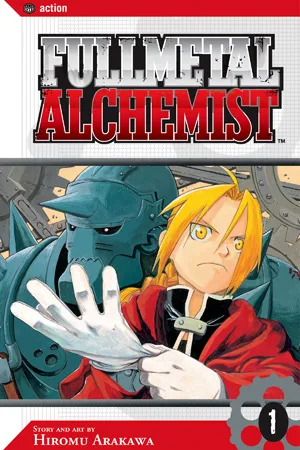
The standard VIZ Fullmetal Alchemist Vol. 1, listed at 192 pages. Cover via VIZ Media product page.
The same series can make both options sensible. A reader sampling Fullmetal Alchemist may prefer the 192-page standard volume VIZ lists, while a collector who wants fewer separate books may choose its 576-page 3-in-1 edition. Both are official records for the same Japanese-origin series. The format changes the object, not the underlying identity of the story.
That distinction also protects you from misleading listings. A seller can write “volume one” without making clear whether it is a standard volume, a 2-in-1, a 3-in-1, or a deluxe book. Follow the publisher's title, source range, page count, and trim instead of relying on a marketplace label.
Single volumes: the flexible choice
Single volumes are the best fit for sampling, lending, and building a run one book at a time. Each purchase is usually lighter and easier to match with the standard line. The trade-off is a larger spine count, more opportunities for a gap, and more checking when a long series has multiple English editions.
Why single volumes work well
A standard volume gives you a small commitment. You can read it, decide whether the series deserves more shelf space, and keep your collection aligned with a normal volume-number sequence. If you already own several books, adding the next single volume is usually less confusing than translating an omnibus range into missing numbers.
The format is also easier to handle in short sessions. A 192-page Fullmetal Alchemist Vol. 1 from VIZ has the same 5 by 7 1/2 inch trim that appears on the publisher's 3-in-1 listing, but it is much lighter because it contains one standard collected volume. The publisher's pages make the difference visible without requiring a guess about paper thickness.
The trade-offs
Single volumes take more room when a series runs for dozens of books. Older volumes can also disappear from a current catalog while a combined edition remains available. If you switch formats halfway through, write down the source-volume range so you do not buy duplicate material or skip a section.
Single volumes are not automatically more collectible or better made. They are simply a smaller unit. Judge the edition by the publisher, territory, contents, and condition, not by the idea that a thinner book must be the premium choice.
Omnibus editions: 2-in-1 and 3-in-1 trade-offs
An omnibus reduces several source volumes to one physical unit, which is useful for shelf space and continuous reading. The cost is physical weight and less granular purchasing. The publisher's page is essential because a 2-in-1 may cover volumes 1 and 2, while a different line's 3-in-1 may cover volumes 1 through 3 and use a different trim.
2-in-1 editions
VIZ's official Ranma 1/2 (2-in-1 Edition), Vol. 1 says it contains volumes 1 and 2 and lists 360 pages for the paperback. VIZ's series page lists 19 books in that 2-in-1 edition. This is a good example of why the edition count is not the source volume count: AniList records the Japanese series as 38 volumes and 407 chapters, while the English 2-in-1 line has fewer physical books.
AniList identifies Ranma 1/2 as countryOfOrigin: JP, status: FINISHED, and isAdult=false. Those fields describe the manga record, not the number of English paperbacks on a shelf. When you log your collection, keep both numbers: source series volumes and edition books.
3-in-1 editions
Kodansha's official Fire Force Omnibus describes a 3-in-1 edition containing volumes 1 through 3 and lists 592 pages for its first book. The page lists 12 omnibus volumes available. Kodansha's standard Fire Force series page separately lists 34 standard print volumes, so the two numbers are not contradictory.
AniList records Fire Force as countryOfOrigin: JP, status: FINISHED, 305 chapters, and isAdult=false. The literal status is important: “12 omnibus volumes available” is an edition count, not an ongoing-series claim. Compare the source record and publisher catalog as two related but separate facts.
Before mixing editions, use the to confirm that the publisher, imprint, format, and contents on a listing match a real official record.
bootleg manga checklist
Deluxe editions: when the physical object matters
Deluxe editions make sense when you care about a larger reading surface, a sturdier binding, bonus material, or a distinct shelf presentation. They often collect several source volumes, but “deluxe” does not promise one fixed range. Check the exact product page for contents, page count, trim, and the number of books currently listed.
A larger range can change the reading experience
Kodansha's Vinland Saga Deluxe page says the premium hardcovers include volumes 1 through 3 of the Japanese edition and new bonus content. It lists 688 pages for Deluxe Vol. 1 and eight deluxe volumes available on the page checked for this guide. That is a substantial reading block, so the format suits a collector who wants the presentation as much as the story.
AniList records Vinland Saga as countryOfOrigin: JP, status: FINISHED, 224 chapters, 29 source volumes, and isAdult=false. Kodansha's catalog page labels its deluxe line “Ongoing” because that edition is still being released. Do not turn that edition label into a claim that the source manga is unfinished. The fields answer different questions.
Deluxe does not mean one standard size
Attack on Titan shows the difference clearly. Kodansha's Attack on Titan Omnibus describes a giant-sized 3-in-1 book with almost 600 pages and lists 592 pages for its first volume. Its Colossal Edition says the first book includes source volumes 1 through 5 in an extra-large 7 by 10.5 inch format, with 15 color pages and 970 pages, and lists seven books in the edition.
AniList records Attack on Titan as countryOfOrigin: JP, status: FINISHED, 141 chapters, 34 source volumes, and isAdult=false. The series is finished, while the two English lines package those chapters differently. If you are choosing between them, page block and trim are more useful than the shared series title.
Edition examples: publisher records worth comparing
The examples below are not a ranking of stories. They are format case studies. Each series was checked in AniList on October 8, 2026 for Japanese origin, adult flag, literal status, and chapter data. Each named print line was checked on the publisher page for its source-volume range or stated physical specifications.
Fullmetal Alchemist: one story, two useful baselines
AniList lists Fullmetal Alchemist as countryOfOrigin: JP, status: FINISHED, 116 chapters, 27 source volumes, and isAdult=false. VIZ lists a standard Fullmetal Alchemist Vol. 1 at 192 pages and a Fullmetal Alchemist (3-in-1 Edition), Vol. 1 at 576 pages. Both pages list a 5 by 7 1/2 inch trim.
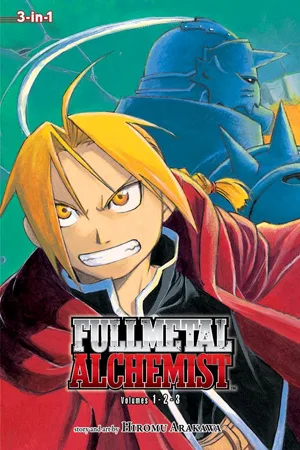
The VIZ 3-in-1 Vol. 1 prints its source range on the cover; VIZ lists it at 576 pages. Cover via VIZ Media product page.
This is the cleanest comparison for a reader who wants to understand format without changing series. The standard book is easier to carry and sample. The 3-in-1 reduces the number of books and creates a longer reading session. The publisher's page count gives you a concrete handling difference instead of a vague “thicker book” warning.
One Piece: an omnibus for an ongoing source
AniList lists One Piece as countryOfOrigin: JP, status: RELEASING, isAdult=false, with no chapter or volume total in the live record checked for this guide. VIZ's One Piece (Omnibus Edition), Vol. 1 collects the first three source volumes, lists 608 pages, and uses a 5 by 7 1/2 inch trim. VIZ's standard One Piece Vol. 1 lists 216 pages in the same trim.
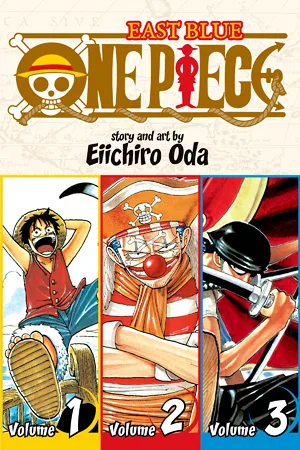
VIZ's One Piece omnibus shows its three source volumes as three cover panels. Cover via VIZ Media product page.
Readers on r/MangaCollectors are split on this exact book. In a thread asking whether the One Piece omnibuses are "really that bad," one reply said: "The problem with them is that the binding quality isn't good enough for their size." The same reply added that "pages falling out is way more common than in single volumes." Another reader in the same thread took the other side: "I like omnibus because it's cheaper and compact which means I can hold more books in one hand and saves more shelf space."
Thread: r/MangaCollectors, "Are One Piece omnibuses really that bad? And omnibuses vs singles" (via Reddit embed).
The useful lesson is about commitment. An omnibus can make an ongoing series easier to start, but it does not make the source series complete. Keep the publisher's edition range next to AniList's RELEASING status when you plan a collection.
Ranma 1/2: a 2-in-1 line with a clear endpoint
AniList lists Ranma 1/2 as countryOfOrigin: JP, status: FINISHED, 407 chapters, 38 source volumes, and isAdult=false. VIZ's 2-in-1 paperback contains source volumes 1 and 2, has 360 pages, and its series page lists 19 edition volumes with the nineteenth marked as the final volume.
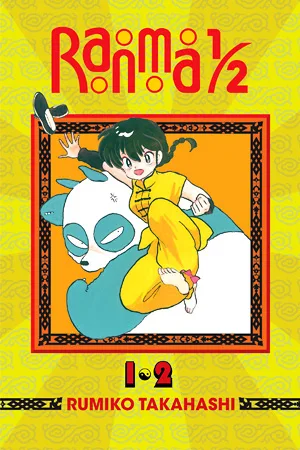
The 2-in-1 cover marks its source range as 1・2. Cover via VIZ Media product page.
This is a good format for a reader who wants fewer books without moving to a large 3-in-1 page block. It also has a clean collection endpoint: the source has 38 volumes and the named English 2-in-1 line has 19 books. Verify the current series page before buying because catalog availability can change.
Attack on Titan: omnibus versus Colossal
AniList lists Attack on Titan as countryOfOrigin: JP, status: FINISHED, 141 chapters, 34 source volumes, and isAdult=false. Kodansha's omnibus line collects three source volumes per book and lists 592 pages for Vol. 1. The Colossal line collects five source volumes in its first book, uses a 7 by 10.5 inch trim, and lists 970 pages for Vol. 1.
The choice here is less about whether the story is complete and more about the physical scale you want. The omnibus is already a large reading block. The Colossal edition pushes further toward oversized presentation and a smaller spine count. Measure your shelf and think about how you read before choosing the larger book.
Vinland Saga: deluxe range plus bonus content
AniList lists Vinland Saga as countryOfOrigin: JP, status: FINISHED, 224 chapters, 29 source volumes, and isAdult=false. Kodansha says its Deluxe line contains Japanese volumes 1 through 3 plus new bonus content and lists 688 pages for Deluxe Vol. 1.
This is the case for buying a deluxe edition because the edition itself is part of the appeal. The source story is finished in AniList, but the deluxe catalog can continue listing new books as the English line catches up. Keep those timelines separate in your collection notes.
The covers storage, format mixing, and how to record source-volume ranges so a shelf stays readable after you add an omnibus.
manga collecting guide
Step-by-Step
Use this process for any series with multiple official print lines. It keeps the decision tied to the exact edition rather than the format label alone.
- Name the reading goal: Decide whether you want to sample a story, build a complete run, reduce shelf spines, or own a premium physical edition.
- Check the source series: Open AniList and record
countryOfOrigin,isAdult, the literalstatus, and the available chapter or volume fields. Do not inferFINISHEDfrom a publisher's “complete” package label. - Open the publisher record: Find the exact standard, 2-in-1, 3-in-1, or deluxe page. Record the source-volume range, page count, trim, binding notes, bonus content, and edition volume count when listed.
- Translate the range into your shelf: If you own standard volumes 1 through 4, do not buy an omnibus containing those same source volumes unless the duplicate is intentional. Write ranges such as “omnibus 1 = source 1-3” in your notes.
- Test the physical scale: Compare page count and trim with a book you already enjoy holding. A 600-page omnibus can be a good value in shelf space and a poor fit for reading in bed.
- Check the endpoint: A finished source can have an incomplete English line, and an ongoing source can have a complete first box or current omnibus run. Confirm both the series status and the edition's available range.
- Choose one format family first: Build a consistent standard, omnibus, or deluxe run before mixing. If you switch later, keep the source-volume map beside your collection list.
- Recheck the live listing: Publisher pages, availability, and edition counts change. Verify the page again at purchase time, and do not rely on an old screenshot or a remembered price.
Tips: make the choice fit your reading habits
The best format is the one you can hold, store, and finish. A few practical checks prevent most regrets.
Measure the page block, not just the spine count
Fewer books can mean more weight per book. If you read standing, commute with a book, or lend volumes to friends, a standard line may be more comfortable even when it takes extra space. If your main concern is a narrow shelf, the heavier omnibus may be worth it.
Keep edition notes next to chapter notes
AniList chapter counts describe the source record. Publisher pages describe English print products. Record both when you plan a run. “Fire Force, 305 chapters” and “Fire Force Omnibus, 12 books listed, 3 source volumes in the first book” are different facts, and both can be useful.
Match trim before mixing lines
Two books with the same story title can have different heights, widths, and page weights. Check the publisher's trim field when available. A standard paperback beside a 7 by 10.5 inch oversized book may look intentionally varied or simply awkward, depending on your shelf goal.
Treat bonus material as a separate reason to buy
Bonus pages, color pages, and new content can justify a deluxe line for a collector. They should not be assumed from the word “deluxe.” If the publisher does not name an extra, leave it out of your comparison.
Avoid prices from memory
Prices move by region, retailer, format, and date. Compare the live publisher or authorized retailer listing when you are ready to buy. This guide focuses on contents, physical scale, and reading fit so its format advice does not age with a sale price.
Common Mistakes: avoid a mismatched collection
The most common mistake is treating all volume numbers as interchangeable. A standard Vol. 4, a 2-in-1 Vol. 4, and a deluxe Vol. 4 may contain different source ranges. Write the publisher's range beside the book number before you add it to your list.
Another mistake is calling an edition complete because its product page lists a final book. The source manga may still be RELEASING, or the English line may cover only one section of a finished source. Read AniList's literal status field and the publisher's contents statement separately.
Finally, do not use an old price, seller photograph, or collector comment as the product record. Start at the publisher, verify the edition is real and currently listed, then use an authorized route. If a physical copy cannot be matched to that record, pause and document the mismatch.
Our Take: buy the format you will actually read
Singles are the safer start. They are lighter, easier to sample, and easier to match. An omnibus pays off on a series you already want, when shelf space matters more than weight. Readers in the One Piece thread above split over binding and paper on that book. A deluxe edition is worth it when the hardcover, the larger trim or the bonus pages are what you want. In every case, read the publisher's source range and page count before the label. This take rests only on the VIZ and Kodansha product pages, AniList records and reader comments cited above.
Related Reading
Advertisement
- Manga Collecting Tips: Formats, Storage, and Smart Buying
- Best Manga Box Sets: Complete Runs and Starter Sets
- How to Spot Bootleg Manga Before Buying
- Where to Buy Manhwa Physical Volumes in the US
- Manga vs Manhwa vs Manhua Explained
- Manga First Print Guide: Number Lines, Obi, and Colophons
- Manga Box Sets Coming Soon: 6 Confirmed 2026-2027 Packages
Frequently Asked Questions
What is the difference between a manga omnibus and a single volume?
A single volume is one book in a standard collected line. An omnibus combines two or more source volumes into one book. Check the publisher's edition page for the range, pages, trim, and extras because the label alone does not define the format.
Is an omnibus better for a beginner?
It can be, if you already want the series and prefer a longer reading block. A single volume is safer when you are sampling a new story or want to buy gradually. Start with the format you can hold comfortably and the edition you can match consistently.
How do I know what an omnibus contains?
Use the official publisher page. Look for a sentence naming source volumes, such as “contains volumes 1 and 2,” or a product description that specifies a 3-in-1 range. Do not infer the range from the cover, book thickness, or a marketplace title.
Does a finished manga always have a finished omnibus line?
No. AniList's FINISHED status describes the source manga, while a publisher's omnibus line can still be releasing, incomplete in a territory, or unavailable. Check the source status and the current edition catalog as separate records.
What should I check before mixing manga formats?
Record the source-volume range, page count, trim, and publisher for every book. Compare the range with what you already own, then check whether the new book will sit at a different height or weight. Avoid duplicate source volumes unless you want both editions intentionally.
Are deluxe manga editions worth it?
They are worth considering when the larger format, binding, bonus content, or shelf presentation matters to you. They are less practical if you mainly want a light portable book. Read the publisher's exact contents and physical specifications before deciding.
How We Checked This
Eighteen source pages were checked on October 8, 2026. They are six VIZ product or series pages, five Kodansha series pages, six AniList records, and one r/MangaCollectors thread. Page counts, trims, source ranges and edition volume counts were read from the publisher pages. Status, chapter and volume totals come from AniList. The covers in this guide come from the same VIZ product pages. Each fact has a row with a quoted line in our sources table.
Last reviewed: October 8, 2026
References
- AniList: Attack on Titan and Kodansha Attack on Titan Omnibus
- AniList: Ranma 1/2 and VIZ Ranma 1/2 2-in-1 Vol. 1
- AniList: Fire Force and Kodansha Fire Force Omnibus
- AniList: Vinland Saga and Kodansha Vinland Saga Deluxe
- AniList: Fullmetal Alchemist and VIZ Fullmetal Alchemist 3-in-1 Vol. 1
- AniList: One Piece and VIZ One Piece Omnibus Vol. 1
- VIZ Ranma 1/2 (2-in-1 Edition) series page
- Kodansha Attack on Titan Colossal Edition and Kodansha Fire Force (standard edition)