
TL;DR: Manga first print checks start inside the copy: read the US copyright page or Japanese colophon, then match the publisher's record. A number line or printing line is stronger evidence than an obi, cover, ISBN, or release date alone. Keep first print, first edition, and reprint notes separate.
This is a source-first guide to Japanese manga and official English print editions. It explains what you can actually check in a book, and what the check cannot prove. It does not estimate prices, rarity, or resale value. Prices and availability move, so check current official listings rather than trusting a remembered number.
The collecting framework starts in Manga Collecting Tips: Formats, Storage, and Smart Buying. For a different question, see Manga Omnibus vs Single Volumes when you are choosing a format, or How to Spot Bootleg Manga when a copy may not match an official edition. Those guides cover the broader shelf and counterfeit checks; this one focuses on identifying a printing within a real manga edition.
Overview: what manga first print actually means
To identify a manga first print, first identify the exact edition, then read the printing information in the copy and compare it with the publisher's product record. US editions often put evidence on a copyright page or in a number line. Japanese tankobon use the colophon. An obi, ISBN, or release date can support the match but cannot prove the printing alone.
“First print” is a physical-copy claim, not just a search result label. A publisher can release one edition, print it again, and keep much of the same cover and bibliographic data. The series may also have a Japanese tankobon, a US paperback, an omnibus, and a deluxe line that are all official but not the same product.
That is why a reliable check begins with territory and format. Write down whether the book is Japanese or English, which publisher or imprint appears on it, which volume it claims to be, and whether it is a standard volume or a combined edition. Only then compare the printing clue.
Key Takeaways: read the copy, not the listing
The strongest first-print check comes from the book's own printing information matched to the exact publisher record. A first-print-only insert or a clear first-print statement is useful evidence. Cover art, an obi, an ISBN, and a release date are helpful for identifying the edition, but none should be treated as a certificate for the copy.
- Treat first edition and first print as separate fields in your notes.
- Identify language, territory, publisher, imprint, format, and volume before inspecting rarity claims.
- Read a US copyright page or number line when the edition provides one.
- Read a Japanese tankobon colophon for the
第1刷or later刷notation. - Use the publisher's own product page to match the cover, format, contents, and any first-print feature.
- Treat an obi as supporting packaging evidence, not proof that the copy is first print.
- Do not quote a price or call a copy rare without a current, reliable source. This guide does neither.
- If the evidence is incomplete, label the copy “unverified” instead of making a stronger claim.
Manga first print vs first edition
Advertisement
An edition describes the product design, language, territory, or format. A printing describes a production run within that edition. A book can belong to a first edition while being a later printing, and a later edition can have its own first printing. The ISBN and cover may remain unchanged, so the printing line matters.
Collectors often use “first edition” and “first print” as if they were interchangeable. They are not. In a log, use separate columns such as edition, printing, territory, format, and evidence. That prevents a first release date from being mistaken for proof that the particular copy was printed on that date.
An ISBN is most useful for narrowing the product. It can help you find the publisher page for the same language, volume, and format. It normally cannot tell you whether your copy is the first, second, or later printing of that product. Do not upgrade the claim just because the number matches.
The same caution applies to a catalog release date. The date identifies when a product was released, not the manufacturing history of every copy sold afterward. Use the date to check identity, then open the book and look for the printing evidence.
US English manga: check the copyright page and number line
For a US English edition, open the book and look for the copyright or publication page near the front. Depending on the publisher and edition, the page may include a number line, a first-edition statement, publication data, or a note about an item included only with the first printing. Use the actual page and the publisher's record together.
Number lines are useful because they can record the lowest printing number still present in the book. In the common form described in Wikipedia's printer's key entry, if the "1" is still there the copy is the first printing of that edition. The same entry notes that the structure is not uniform, so do not apply a single collector rule to every publisher or year. Photograph the whole page, not only the digits, and record the surrounding copyright and edition text.
Collectors on r/MangaCollectors give the same short rule. One reply in a first-print PSA thread puts it this way: "There is a sequence of numbers in the back of the book. If the last number is a 1 it's a FIRST PRINT." Treat that as the quick read, then check the rest of the page.
An official VIZ product page for Yu-Gi-Oh! 5D's Vol. 1 states that the card included with the first printing only. That is strong evidence about the product's first-print feature. It is not proof that a particular copy is first print unless the copy also has the feature and matches the rest of the edition record.
AniList identifies Yu-Gi-Oh! 5D's as countryOfOrigin: JP, status: FINISHED, 68 chapters, 9 volumes, and isAdult=false in the live record checked for this guide. Those fields verify the series identity. The VIZ product page verifies the English edition detail. Neither source should be stretched into an unsupported claim about a specific used copy.
Japanese tankobon: read the colophon and printing line
For a Japanese tankobon, look for the colophon, known in Japanese as 奥付, usually on an interior page near the end. The Japanese Wikipedia entry on 奥付 lists the edition and printing numbers among the details it normally carries. A line containing 第1刷発行 means first printing, while a higher 刷 number records a later printing. Copy the date and printing notation exactly, then compare the title and volume with the publisher's bibliographic record.
The colophon is an interior publication record, so it is more useful than an online listing that simply says “first print.” It still needs context. Read the whole page, confirm the volume, and check that the language, publisher, imprint, and format belong together. A copied or mismatched page is a reason to investigate, not a shortcut to certainty.
Shueisha's official warning about an illegal printed Demon Slayer: Kimetsu no Yaiba set, dated February 18, 2021, says the colophon of volume one in those pirate sets read 2020年6月30日第39刷発行, a 39th printing. The same notice says the sets appear to have been made by scanning one genuine copy. So a pirate book can carry a real-looking printing line. The colophon tells you which printing a book claims to be. It does not prove the book is genuine.
AniList identifies Demon Slayer: Kimetsu no Yaiba as countryOfOrigin: JP, status: FINISHED, 207 chapters, 23 volumes, and isAdult=false. Shueisha's warning is the publisher source for the colophon example. Keep those sources in their lanes: AniList identifies the series record, while the official notice demonstrates the kind of interior detail to read.
Obi, cover, ISBN, and other supporting clues
An obi, cover, ISBN, and release date help identify an edition, but they are supporting clues rather than standalone first-print proof. Match them to the publisher's page, then prioritize the interior printing line or a clearly documented first-print-only feature. A missing obi may reflect packaging history, while a present obi may have been moved between copies.
The cover can tell you whether the title, volume number, imprint, and design are plausible for the edition. It can also reveal a territory mismatch. It cannot tell you whether the same cover was used for a later printing unless the publisher records a visible change.
The ISBN narrows the product record. Check all of the surrounding fields: title, volume, language, territory, format, publisher, and page count when listed. A valid number printed on the wrong format is still a mismatch. Do not publish a fabricated ISBN or fill an absent field from memory.
The obi is especially easy to overread. It can carry campaign copy, a release notice, or a format-specific message, but it is removable and condition varies. Record whether the obi is present, which edition it names, and whether its text matches the book. Then return to the colophon or copyright page.
Publisher records: three safe comparison examples
These three examples show different kinds of evidence without turning a product page into an authenticity certificate. AniList was checked for Japanese origin, adult flag, literal status, and chapter data. The publisher source was checked separately for the edition detail. Chapter counts describe the source work, while printing evidence describes one physical product.
Yu-Gi-Oh! 5D's: a first-print-only insert
The VIZ page for Yu-Gi-Oh! 5D's Vol. 1 explicitly says its card was included with the first printing only. Use that statement as a checklist item: record whether the card is present, match the cover and product identity, and inspect the copyright page. Do not assume that a card alone authenticates a copy.
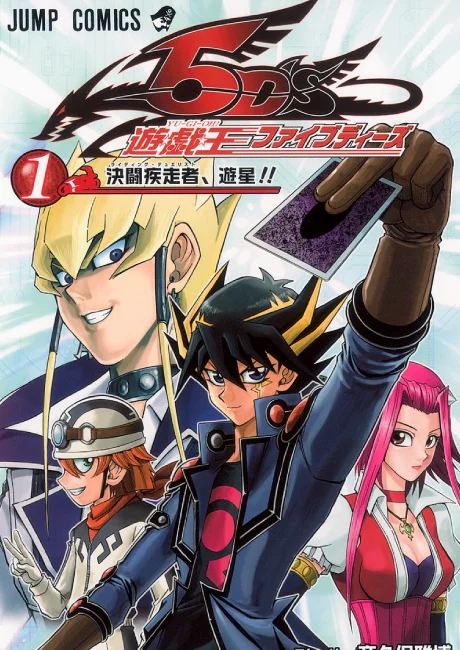
The Japanese volume one cover identifies the series for this case study; it does not prove the printing of an individual copy. Cover via AniList.
Demon Slayer: a colophon example in an official warning
Shueisha's official warning about an illegal printed set is useful for two reasons. It shows the kind of colophon line collectors should record, and it shows that a copied colophon is not enough on its own. The physical differences Shueisha named were a thinner spine and a price line on the volume 4 cover that lacked its ruled box. Treat the printing notation as publication evidence to record, not as a price or rarity signal.
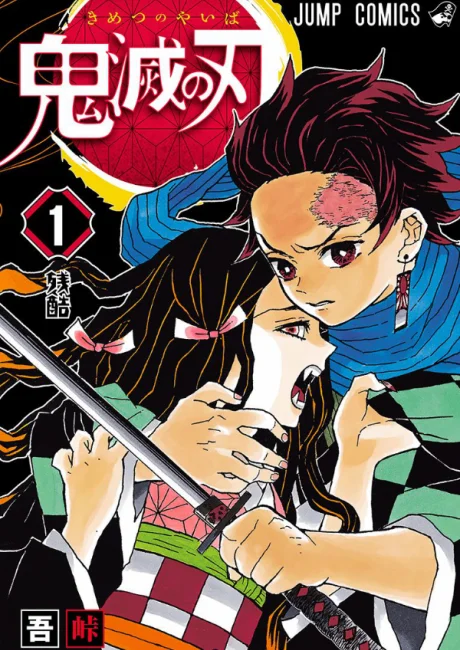
The Japanese volume one cover is a series reference for this case study; it is not evidence that a particular copy is first print. Cover via AniList.
AniList records Demon Slayer: Kimetsu no Yaiba as FINISHED, with 207 chapters and 23 volumes, and the adult flag is false. That status is about the source manga, not the printing status of a physical copy. Keep the two questions separate in your collection log.
One Piece: product identity is not printing proof
Shueisha's official One Piece volume one record lists a December 24, 1997 release, 208 pages, and ISBN 4-08-872509-3 for the Japanese product. Those fields identify the bibliographic object. They do not prove that a copy with the same title is a first printing.
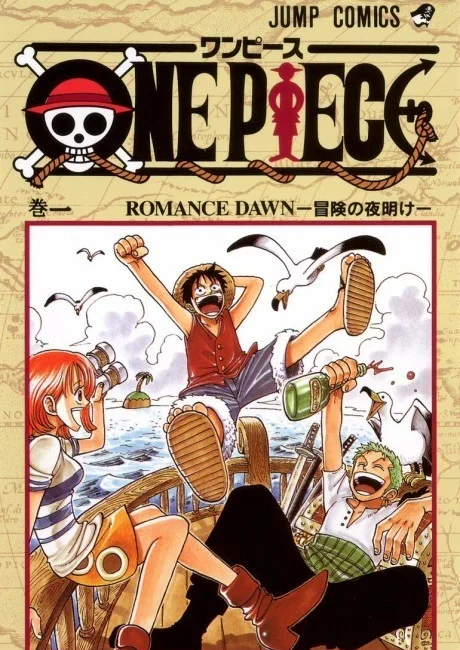
The Japanese volume one cover helps identify the product family; use the copy's colophon for its printing claim. Cover via AniList.
AniList records One Piece as countryOfOrigin: JP, status: RELEASING, isAdult=false, with no chapter or volume total in the live record checked for this guide. Do not replace that literal status with “finished” because a particular box, omnibus, or local release has an endpoint.
The English VIZ volume one is a separate product with its own printing evidence. In one r/MangaCollectors thread, a reader asked whether a VIZ One Piece volume 1 was a first print, and the top reply was: "it is a first print. you can tell because there is still a 1 at the bottom on that row of numbers." The thread below shows the question as it was asked.
Thread: r/MangaCollectors, "Is this a first edition or first print? One piece viz English" (via Reddit embed).
Step-by-Step
Use this sequence for a Japanese tankobon or official US English volume whose listing claims “first print.” It moves from identity to interior evidence, then stops at the strength of the record. If a step cannot be completed, preserve the uncertainty instead of converting a clue into a collector promise.
- Identify the territory: Record whether the copy is Japanese or English, then write down the publisher, imprint, language, volume, and format.
- Name the edition: Find the matching official product page and record its title, cover, format, stated contents, ISBN when supplied, and release details.
- Open the copy: Photograph the copyright page, title page, colophon, number line, and any first-print-only insert before moving or cleaning the book.
- Read the US indicia: For an English edition, look for a number line, first-edition statement, or publisher note about a first-print feature. Copy the surrounding text.
- Read the Japanese colophon: For a tankobon, find 奥付 and record the date and
刷notation, such as第1刷発行or a later printing number. - Record the obi separately: Note whether the obi is present and whether its wording matches the exact edition. Do not treat it as proof by itself.
- Compare the publisher record: Check the complete title, volume, language, format, cover, identifiers, pages, and contents against the official source.
- Apply the stop rule: If the copy combines mismatched details or the seller will not provide interior evidence, call it unverified and do not resell it as first print.
Tips: keep a first-print evidence log
A useful log records observable facts rather than a conclusion you hope to prove. Give each copy a row for series, volume, language, territory, publisher, format, edition, printing notation, obi, ISBN, source URLs, photographs, and date checked. Leave value and rarity out unless a separate current source supports them.
Use the publisher page URL as the identity anchor and the photograph of the interior page as the copy evidence. If you update the record after a reprint or catalog change, keep the old note with its check date. A collector can then see which fact came from the book and which came from a current catalog.
For a Japanese copy, transcribe the colophon rather than relying on an automatic translation. Keep the original characters and a plain-language note. For an English copy, photograph the entire copyright page so a number line is not separated from the edition and publisher information around it.
Do not use an old marketplace listing as your only source. Official product pages can establish edition identity, while official publisher notices can show how publication details appear. Neither removes the need to inspect your own copy.
When the question is format rather than printing, read for publisher-verified source ranges, trim sizes, and handling trade-offs.
Manga Omnibus vs Single Volumes
Common mistakes when checking a first printing
The most common mistake is asking a clue to answer a question it cannot answer. A release date identifies a product, an ISBN narrows an edition, and an obi supports packaging history. The strongest claim should come from the copy's printing line or a publisher-documented first-print feature matched to the correct edition.
Calling every early copy first print
A book bought near release may be an early copy, but the purchase date does not identify its printing. A later shipment can contain a reprint, and a first release can sell through before a buyer gets a copy. Read the interior page instead of using the date of purchase.
Treating first edition and first print as synonyms
Keep the terms separate. If the page says first edition but the copy shows a later printing number, record both facts. If the source does not state the edition or printing, say that the evidence is incomplete.
Treating the cover or obi as authentication
A cover can be copied and an obi can be removed or separated from the book. Use them to compare the edition, not to certify a copy. The publisher record and the interior publication details are more useful together.
Turning a status field into a print claim
AniList's literal FINISHED or RELEASING status describes the source series. It does not tell you whether an English line is complete, whether a box set contains every volume, or whether a copy is first print. Keep series status, edition availability, and individual printing as three separate notes.
If the copy itself may be unauthorized, use for the publisher, imprint, copyright-page, and physical-quality checks that come before a first-print claim.
How to Spot Bootleg Manga
Our Take: the printing line beats every outside clue
The surest first-print check is the one inside the book. A number line that still has its 1, or a colophon that reads 第1刷, tells you which printing the copy claims to be. A matching publisher record tells you which edition it belongs to. Shueisha's pirate notice adds a limit: a scanned copy can carry a real printing line, so physical details still matter. A cover, an obi or an ISBN on its own proves less than any of these. This take rests only on the publisher pages, AniList records and reader threads cited above.
Related Reading
Advertisement
This guide fits inside the site's manga collecting cluster. Start with the hub for format, storage, and buying decisions, then use the sibling guides for the specific physical question in front of you. The site's manhwa buying guides cover Korean comics separately, so do not merge their publisher records with Japanese manga checks.
- Manga Collecting Tips: Formats, Storage, and Smart Buying
- Manga Omnibus vs Single Volumes
- How to Spot Bootleg Manga
- Best Manga Box Sets
- Where to Buy Manhwa Physical Volumes in the US
- Manga Storage and Care: Shelves, Humidity, Light, and Care
- Where to Buy Manga in the US: Official Stores Guide
- Out of Print Manga Guide: Status, Reprints, and Safe Buying: check whether a missing copy is an edition gap, a reprint, or a temporary stock issue.
Frequently Asked Questions
How can I tell if a manga is a first print? Find the printing information in the US copyright page or Japanese colophon, then compare the edition with the publisher's record. A first-print feature such as an insert can help, but an obi, cover, ISBN, or release date alone does not prove the individual copy is first print.
What is the difference between first print and first edition? A first edition is the first edition design or release of a product, while a first print is an early printing of that edition. Later printings can keep the same ISBN and cover. Read the copy's printing line and keep edition and printing as separate notes.
Where is the printing number in a Japanese manga?
Look on the Japanese tankobon's colophon, called an oku-zuke or 奥付, usually near the back of the book. A line such as 第1刷発行 identifies a first printing, while a higher 刷 number identifies a later printing of that edition.
Does an obi prove a manga is first print? No. An obi can support an edition match, but it is removable packaging and may be missing from a genuine copy. Treat it as one clue alongside the cover, colophon or copyright page, ISBN, publisher record, and any first-print-only feature.
Does an ISBN prove a first printing? No. An ISBN identifies a product or edition, not necessarily the printing of the copy in your hands. Use it to match language, territory, publisher, format, and volume with the official record, then inspect the printing information inside the book.
Can a publisher confirm the printing of my copy? A publisher page can verify an edition's identity and stated contents, but it usually cannot inspect a used copy or certify a collector's individual book. Record the physical evidence and contact the publisher through its official channel if an authenticity question remains.
How We Checked This
Ten source pages were checked on October 8, 2026. The edition details come from VIZ's Yu-Gi-Oh! 5D's Vol. 1 page and Shueisha's One Piece volume 1 record. The colophon example comes from Shueisha's 2021 pirate-copy notice, which is now a PDF. Series status and counts come from AniList for all three series. The two Wikipedia entries cover the number line and the 奥付, and the reader quotes come from two r/MangaCollectors threads. Each fact has a row with a quoted line in our sources table.
Last reviewed: October 8, 2026
References
The references below are the live identity and publisher sources used for the named examples. AniList supplies the series metadata fields; the official publisher pages supply product or publication details. They are verification anchors, not links to marketplace sellers, scanlation, piracy, or bootleg listings.
- AniList: Yu-Gi-Oh! 5D's
- VIZ: Yu-Gi-Oh! 5D's Vol. 1
- AniList: Demon Slayer: Kimetsu no Yaiba
- Shueisha: official warning about an illegal printed Demon Slayer set (PDF, February 18, 2021)
- AniList: One Piece
- Shueisha: One Piece volume one bibliographic record
- Wikipedia: Printer's key
- Wikipedia (Japanese): 奥付