
TL;DR: Out of print manga can return in a new edition. Check the publisher's exact wording, separate series facts from edition facts, confirm the title on AniList, and treat retailer stock, resale chatter, and remembered prices as incomplete evidence.
An out-of-print label belongs to a specific printed edition, not automatically to every copy of a story. The useful question is not whether a marketplace listing looks expensive. It is whether the publisher still documents that edition, has announced a replacement, or has described a return to print. This guide shows how to make that check without guessing.
This is a Japanese manga collecting guide. Korean manhwa has a separate supply chain, so use Where to Buy Manhwa Physical Volumes in the US and Yen Press Manhwa Physical Releases 2026 for that side of the shelf. The broader format and storage framework starts in the site's Manga Collecting Tips guide.
Overview: what does out of print manga mean?
Out of print manga is a printed edition that its publisher no longer keeps available as part of its active production or catalog. That status can apply to one English volume, a whole licensed line, or an older edition replaced by a new one. It does not prove that every copy is rare, valuable, or impossible to replace.
Kodansha's own explanation is a useful baseline: "sometimes printed manga titles become no longer available: they go 'out of print,'" and the publisher has brought some of them back as digital "rescues." That wording separates three things collectors often merge: the old print edition, a later digital format, and the status of the original series. Keep those as separate notes in your collection log.
The phrase can also hide a scope problem. “MARS is out of print” may refer to the old English release, while a new anniversary edition is now being published. “Volume 4 is out of print” may refer to one paperback while a hardcover omnibus covers the same source material. Always attach the status to a language, publisher, format, and volume range.
Key Takeaways for an out of print manga search
The safest out of print manga check starts with the publisher, then uses AniList to identify the Japanese source record. A retailer page can show a temporary stock gap, and a second-hand listing can show demand, but neither one establishes the publisher's production status. Treat dates, formats, and edition boundaries as evidence you record, not details you fill in from memory.
- Publisher wording beats marketplace wording: “Out of print,” “new edition,” and “digital rescue” answer different questions.
- Edition identity matters: record the language, territory, publisher, imprint, format, volume, and source-volume range.
- AniList is a series check: use its literal
countryOfOrigin,status, chapter, volume, andisAdultfields; do not use it as a substitute for an English edition catalog. - Sold out is not out of print: a retailer may be waiting for a restock, reprint, or distributor shipment.
- A replacement can change the count: new translations, 2-in-1 books, and collector editions can produce a different English volume total.
- Digital access does not restore a print line: a digital rescue can preserve access while the old paper edition remains unavailable.
- Prices and availability move: do not use a remembered price or a resale listing as proof of rarity.
- Use official routes: buy through a publisher or an authorized retailer named by that publisher, and avoid unauthorized copies.
How to verify out of print manga status
To verify out of print manga status, identify the exact edition first and then read the publisher's current catalog and news language. Check AniList separately for the source manga's literal fields. If the publisher only shows a retailer link or a temporary stock message, report that evidence honestly as availability information rather than upgrading it to a permanent status claim.
Start with the exact edition
Write a five-line identity record before searching:
- Original title and English title
- Japanese source series and AniList URL
- English publisher or imprint
- Format and language
- Volume number or source-volume range
This prevents a common collecting error: finding a current deluxe edition and assuming it proves that an older paperback is still in print. It also prevents the reverse error, where one unavailable paperback makes a whole series look abandoned even though a replacement format is active.
Read the publisher's verbs carefully
Publisher language carries more weight than a product card's stock label. “Out of print” is direct. “Returns in a new edition” points to a replacement. “Available digitally” establishes a digital route, not a paper reprint. “No longer licensed” describes rights, but may not answer whether existing copies are still being produced or sold.
Save the page URL and the date you checked. A catalog can change when a volume is added, a license moves, or an old product page is retired. If a publisher page disappears, say that the record is no longer available for verification. Do not turn a missing page into a confident claim about why it disappeared.
Match the series record without mixing counts
AniList helps confirm whether you are talking about the right work. Its chapter and volume fields describe the source record, while a US publisher's page describes a particular English package. Those numbers can differ without either page being wrong. Record both labels, and write “edition-specific” when the package changes the count.
For this guide, all three case studies were checked live in AniList. MARS is countryOfOrigin: JP, status: FINISHED, 41 chapters, 15 volumes, and isAdult=false. Mushishi is JP, FINISHED, 50 chapters, 10 volumes, and isAdult=false. Rave Master is JP, FINISHED, 298 chapters, 35 volumes, and isAdult=false. Those are source-series facts, not claims about current print stock.
Verified out of print manga returns
These out of print manga examples show three different outcomes: an old English line replaced by an anniversary edition, a documented return to a new collector format, and a digital rescue whose publisher catalog still distinguishes print from digital. They are evidence for how to research status, not a promise that any particular volume is available when you read this.
MARS: an old English edition replaced by a new hardcover line
 MARS, Japanese volume one. Cover via AniList.
AniList identifies Fuyumi Soryo's MARS as a Japanese manga with literal status FINISHED, 41 chapters, 15 source volumes, and isAdult=false. The AniList MARS record is useful here because it fixes the identity and source count before you examine the English edition.
Kodansha's MARS 30th Anniversary Edition page is unusually clear about the old English release. It says that the 2002 English edition had been out of print for decades, then documents a return with a new translation, new cover illustrations, and collectible 2-in-1 hardcovers. On October 8, 2026, the live catalog listed two volumes available, labeled the edition's status "Ongoing," and described the format as print.
Do not convert those two catalog volumes into “the English edition has two books.” They are two books in the new anniversary line at the time of this check, while the source record has 15 volumes. The publisher page is the authority for the new package, and AniList is the authority for the source-series fields.
Mushishi: a documented return after a long print gap
 Mushishi, Japanese volume one. Cover via AniList.
AniList lists Mushishi by Yuki Urushibara as JP, FINISHED, with 50 chapters and 10 volumes. Its isAdult=false field also keeps this case inside the guide's all-ages collecting scope. See the AniList Mushishi record for the live source identity and literal status.
Kodansha's Mushishi Collector's Edition Volume 3 page documents a print edition released on September 22, 2026. The page lists 514 pages and says the book contains source Volumes 5 and 6. Kodansha's print-license announcement supplies the historical context: it describes the line as a hardcover omnibus with a completely original translation, and says English copies had been out of print for 15 years.
This is the kind of evidence a collector wants: a publisher statement about the old gap plus a current edition page that names the new format and source range. It still does not make every earlier English volume interchangeable with the collector's edition. Keep the edition title and source-volume range in your notes.
Rave Master: a digital rescue is not a full print revival
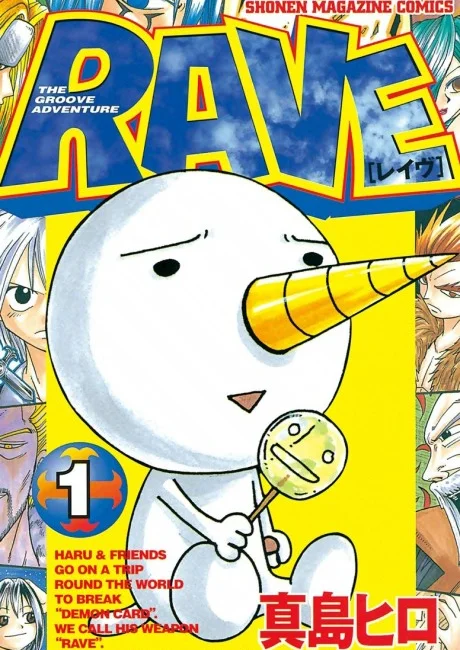 Rave Master (Groove Adventure Rave), Japanese volume one. Cover via AniList.
AniList records Rave Master under its original title Groove Adventure Rave as JP, FINISHED, with 298 chapters, 35 volumes, and isAdult=false. The AniList Rave Master record gives the source-series boundary. Kodansha's Rave Master catalog separately labels the series Complete, lists 35 books, and shows both print and digital formats in the catalog.
The format detail matters. Kodansha's Volume 33 record documents both a digital and a print edition for that specific volume, including the print release record. The current catalog does not prove that all 35 books are available as a complete new print run. Kodansha's digital rescue announcement explains why an older printed title can return digitally without becoming a fully reprinted paper line. That 2017 post says Rave Master was originally a Tokyopop title, had been out of print for almost a decade, and that all 35 volumes were coming back through Kodansha's digital retail partners.
For a collector, Rave Master is therefore a warning against a tidy but unsupported sentence such as “the complete print set is back.” The defensible note is narrower: the source is finished, the publisher catalogs 35 books, the catalog includes digital access and at least a documented print edition for Volume 33, and the old digital rescue has its own history.
If the copy is real but you need to distinguish a first printing from a later reprint, use the for number lines, colophons, and edition boundaries.
Manga First Print Guide

Step-by-Step
Use this out of print manga workflow when a volume is missing from a store, a listing claims rarity, or a new edition has appeared. The sequence is deliberately boring: identify the product, check primary records, and write down what the evidence can and cannot prove before you spend money.
- Name the target edition: Write the series, language, territory, publisher, imprint, format, volume, and source-volume range if the page supplies one.
- Open the publisher catalog: Search the publisher's own series and book pages before opening a marketplace listing or a resale discussion.
- Read the status wording: Separate “out of print,” “out of stock,” “digital,” “new edition,” “reprint,” and “no longer licensed.” Copy the exact idea into your notes without making it stronger.
- Match the source record: Check AniList's title,
countryOfOrigin, literalstatus, chapters, volumes, andisAdultfields so a similarly titled work cannot slip into the record. - Check publisher news: Look for a license announcement, anniversary return, reprint notice, or replacement-format statement from the publisher. Use the date on that announcement.
- Compare the package: Confirm whether the new book is a standard volume, omnibus, 2-in-1, collector edition, or revised translation. Count source volumes and English books separately.
- Choose a legitimate route: Follow the publisher's own purchase or authorized-retailer links. If only a second-hand listing remains, treat it as a potential source of a used copy, not proof of status or value.
- Record the check date: Save the URLs, edition name, status wording, and date. Recheck before buying because catalogs and stock change.
Analysis: out of print manga vs sold out
Out of print manga and sold-out manga describe different points in the supply chain. Out of print is a publisher or edition claim. Sold out is usually a retailer's inventory state. A volume can be sold out while a publisher plans a reprint, or it can remain listed by the publisher while one store has no stock. The next research step depends on which signal you saw.
| Signal you see | What it establishes | What to check next |
|---|---|---|
| Retailer says out of stock | That store cannot ship it now | Publisher catalog and other authorized retailers |
| Publisher says out of print | The named print edition is no longer kept in active print | Replacement editions, license news, or digital availability |
| Publisher lists a new edition | A current package exists | Source-volume range, translation, format, and which old edition it replaces |
| Publisher lists digital only | A digital route is documented | Whether any print edition remains active |
| Marketplace calls it rare | A seller is making a description | Publisher evidence and the exact edition identity |
| License announcement names a new publisher | Rights or catalog ownership changed | The new publisher's own series and volume pages |
Collectors run into this gap constantly. In an r/MangaCollectors thread titled "PSA: Out of Stock Doesn't Mean Out of Print!", the poster described choosing to "send an email to the publisher (in this case, Yen Press) and politely inquire about restocks and got a timely response." Their advice: "Just a friendly reminder to not panic when volumes are out of stock and to never pay inflated prices." Not everyone in the thread agreed. One reply pushed back: "In many cases, things that are "OOS" actually are for all intents and purposes OOP." Both points fit the table above. A stock gap is not a status claim, but a long one with no publisher word is worth a direct question.
Thread: r/MangaCollectors, "PSA: Out of Stock Doesn't Mean Out of Print!" (via Reddit embed).
Reprint, new edition, and digital rescue are not synonyms
A reprint usually keeps the same edition identity while producing more copies. A new edition can change the translation, cover, binding, trim, source-volume grouping, or title presentation. A digital rescue changes the format entirely. All three can bring a story back to readers, but they do not make an old paperback current again.
MARS is the clean example of an older English release being replaced by a new anniversary line. Mushishi shows a publisher documenting a print return with a named collector format. Rave Master shows the digital case. Use those distinctions when writing your own catalog notes, because “back in print” can mean different things depending on the source sentence.
A licence gap is a research prompt, not a conclusion
When a publisher stops listing a licensed series, several explanations remain possible: a rights change, a platform migration, an edition replacement, a temporary catalog cleanup, or a genuine end to print production. Unless an official notice states which one happened, keep the wording narrow. “The old product page is no longer visible” is a fact. “The license reverted” needs a source.
Tips: buy and preserve an out of print manga safely
The safest collecting tips do not depend on a price target. Start from the publisher, keep a dated edition log, and let the evidence decide whether you should wait, choose a replacement format, or stop looking for a print copy. Prices and availability move, so a remembered number or a resale asking price has no place in a status check.
- Do not chase a stock gap immediately: wait for publisher wording or a reprint announcement before assuming the worst.
- Do not quote prices from memory: check the current official listing when a price matters, and label the date; this guide intentionally omits price claims.
- Keep edition notes together: store publisher, imprint, format, volume, source range, URL, and check date in one record.
- Avoid unauthorized copies: do not link or recommend scanlations, piracy, bootlegs, or sellers that cannot be tied to an official edition.
- Inspect a used copy against the record: compare language, logo, format, volume, copyright page, and physical details before calling it genuine.
- Protect the book after you find it: stable temperature, controlled humidity, low light, and supported shelving matter more than decorative wrapping.
- Set a stopping rule: if the source cannot be verified, mark the entry unverified instead of paying more for a story about rarity.
Once an edition is in the collection, the covers light, humidity, shelving, handling, and protective materials.
Manga Storage and Care guide
Our Take: ask the publisher before you pay a resale price
Out of print is a claim about one edition, and only the publisher can make it. All three cases here came back in a different form. MARS returned as a new 2-in-1 hardcover line, Mushishi as a collector's edition, and Rave Master as a digital rescue. A retailer's empty shelf is a question to put to the publisher, not an answer. Record the edition, read the publisher's own words, and check the current catalog before treating a high resale price as the only route. This take rests only on the Kodansha pages, AniList records and reader thread cited above.
Related Reading
This guide answers a status question, not every collecting question. Use the site's Manga Omnibus vs Volumes guide when a replacement changes the source-volume grouping, Where to Buy Manga in the US for legitimate shopping routes, and How to Spot Bootleg Manga when a used copy does not match the publisher record.
Frequently Asked Questions
These answers keep the terms narrow because out of print manga research becomes unreliable when stock, licensing, format, and rarity are treated as one status. Use the publisher's exact page for the edition in front of you, then record the date and source fields so a future reprint does not silently rewrite your collection history.
What does out of print manga mean? It means a publisher no longer keeps a specific printed edition available as part of its active line. It does not automatically mean every copy is rare, that the series is finished, or that a digital edition is unavailable. Confirm the publisher's wording and the edition before drawing a stronger conclusion.
Can out of print manga come back? Yes. A publisher can issue a reprint, a new translation, an anniversary edition, or a digital rescue. MARS and Mushishi show two different print-return patterns, while Rave Master shows why a digital return should not be mistaken for a complete new print line.
How can I tell if manga is out of print? Open the publisher's catalog and look for an explicit out-of-print statement, a replacement edition, a current format record, or a licence announcement. A retailer's out-of-stock label is only a supply signal. Record the edition, wording, URL, and date you checked.
Is a sold-out manga volume out of print? No. Sold out describes a retailer's current stock, while out of print describes a publisher's production or catalog status. A sold-out volume may be waiting for a restock or reprint. Check the publisher before treating a temporary gap as a permanent one.
Can a new manga edition change the volume count? Yes. A 2-in-1 hardcover, omnibus, collector's edition, or revised translation can package the same source story into a different number of books. Keep the AniList source volume count separate from the English edition count and use the named publisher page for the package.
Does an ended manga licence mean the series is out of print? A licence change can remove an English edition from a publisher's active catalog, but a licence report alone does not prove every printed copy is out of print. Confirm the publisher record, the exact edition, and any replacement or reversion notice before making that claim.
How We Checked This
Ten source pages were checked on October 8, 2026. They are six Kodansha pages (two catalog pages, two volume pages and two announcements), three AniList records, and one r/MangaCollectors thread. Page counts, release dates, source-volume ranges and edition statuses come from Kodansha. Source-series status, chapters and volumes come from AniList. Each fact has a row with a quoted line in our sources table.
Last reviewed: October 8, 2026
References
These references separate series identity from edition evidence. AniList supplies live fields for the three Japanese manga records. Kodansha supplies publisher wording, product format, and current catalog details. Because availability changes, use each URL as a checkpoint and recheck it before buying rather than treating this guide as a permanent inventory.
- AniList MARS record
- Kodansha MARS 30th Anniversary Edition
- AniList Mushishi record
- Kodansha Mushishi Collector's Edition Volume 3
- Kodansha print-license announcement for Mushishi
- AniList Rave Master record
- Kodansha Rave Master catalog
- Kodansha Rave Master Volume 33
- Kodansha digital rescue explanation and Rave Master return