What is cultivation manhua? It is a Chinese comic where characters train qi to climb a ladder of named stages. The goal is strength, and in the end immortality. AniList's tag calls qi the "life force" of traditional Chinese philosophy. The hook is the climb itself: a weak disciple, a stage you can measure, and a sect that only keeps the strong.
If you're deciding whether to read one, here is the quick test. You'll like cultivation manhua if you enjoy watching a number go up slowly and paying off years later. You won't if you want a story that's over in a hundred chapters: Martial Peak, the series we quote most below, listed 1,628 chapters on Webnovel on October 29, 2026, and AniList still lists it as releasing.
What is cultivation manhua named for? The word itself
Cultivation is a translation of Chinese words for spiritual training. Wikipedia's xianxia article describes a "popular subgenre known as 'cultivation' or 'training'," built on words such as xiulian (training) and xiuxian (training to become a xian, an immortal). Protagonists are "cultivators" who "seek to become immortal beings called xian." The practice is "heavily based on the real-life meditation practice of qigong."
AniList defines its Cultivation tag in plain terms: characters "cultivate qi" through training, "often martial arts-related," to "gain strength or immortality." That last word is what separates it from an ordinary martial arts story. A martial artist wants to win; a cultivator wants to stop being mortal.
Realms: how a cultivation manhua keeps score
Every cultivation story ranks its characters by stage, and the first chapter usually tells you exactly where the hero stands. What it doesn't do is share one ladder with other series: each story names its own stages, and translators don't always keep even one series consistent.
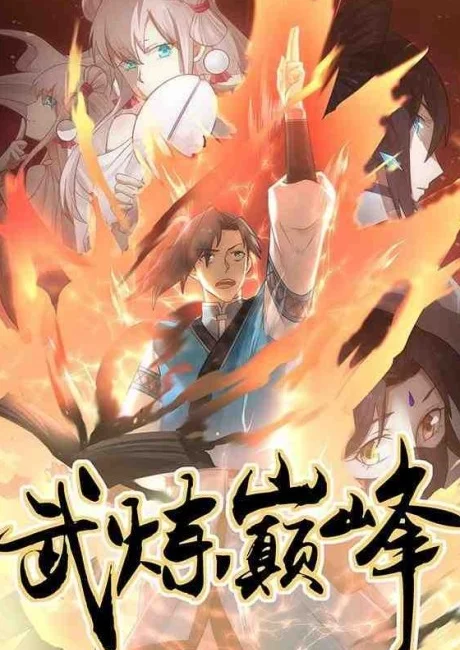 Martial Peak (cover via AniList).
We read chapter 1 of Martial Peak on Webnovel. Its hero, Yang Kai, introduces himself as "a disciple-on-trial of the Lingxiao Martial Arts Sect," then gives his rank as a confession: "I entered this sect three years ago, but I've only managed to reach the third phase of Tempered Body." The narration does the math for you: "Three years for three phases of Tempered Body. This kind of natural talent could no longer be described as 'average', but 'mediocre'." Later in the same chapter, a group of disciples says he is "only still at the third stage of Tempered Body." Phase or stage, the point is the same: the reader knows exactly how far behind he is.
Cultivation Chat Group, a modern-day series, uses the same scoring as a joke. In its chapter 1, which we also read on Webnovel, a user called Thrice Reckless Mad Saber gets a splash page that announces "He Has Reached the Later Phase of the Fifth Stage Spiritual Emperor Realm." The joke works only because readers of the genre already know how a realm title sounds.
Readers notice how fixed these ladders are. In an r/noveltranslations thread titled "Cultivation realms," the original poster wrote: "In almost all novels, cultivation is a step-by-step process with completely predetermined realms and stages." The thread is about novels, but both comic chapters we read follow the same rule: the stage comes first, the person second.
Sects: the school that decides who rises
A sect is the school, employer and pecking order in one, and in a cultivation manhua it's usually the first obstacle. Martial Peak's chapter 1 spends its first pages on the Lingxiao Sect's rules. Every disciple under fourteen gets a three-year trial. Those who "surpass the Tempered Body phases within three years" earn "the right to train under the various masters of the sect." Those who don't must "either leave the sect, or be demoted back to a disciple-on-trial."
The chapter is blunt about the culture: "In this sect, the strong shall stand tall," and the weak "shall be weeded out." It adds that the sect "has over three thousand disciples, but the number of disciples-on-trial were only in the single digits." Yang Kai is one of those few. He opens the chapter sweeping floors; then other disciples note that "five days have passed since he was last challenged" and decide to challenge him again, and before the chapter is out one tells him, "Just lie down on the ground when we hit you and save us all some time!" That is the classic cultivation opening: an outsider at the bottom of a ranked institution, with a clear way up and everyone watching him fail.
Qi, meditation and pills: what cultivating looks like on the page
On the page, cultivating mostly means sitting still. In Martial Peak's chapter 1, Yang Kai drops into a cross-legged pose labeled "chi-recovery meditation" while the other disciples ask "Is he meditating to recover chi?" and mock him for bothering. Wikipedia's list of xianxia powers includes the same practice: qi refining, the "manipulation and nourishment of qi inside the body via meditation and absorption of external energies."
The same list includes pill refining, cooking "rare magical herbs and minerals in a cauldron" into elixirs that can "accelerate qi cultivation," plus talismans and magic arrays. Those give cultivation stories their side plots: herbs to fight over, alchemists to win over, formations to break.


Cultivation vs wuxia vs murim
Cultivation and wuxia share a setting, not a goal. Wikipedia notes that both are "set in a quasi-historical ancient China" with "larger-than-life human protagonists," but xianxia "generally has much more metaphysical themes": immortality, "spiritual growth," "multiple realms of reality." AniList's Wuxia tag describes "the adventures of martial artists in Ancient China," with no immortality in the definition.
Murim is the Korean side of the same family. Korean murim manhwa use the martial world of sects and clans, and our murim explainer sums them up as "sects, clans and revenge in a Chinese-style martial world." The goal there is standing in that world, not leaving mortality behind. Our best cultivation manhwa list mixes both traditions.
Two twists you'll see often: modern settings and systems
 Cultivation Chat Group (cover via AniList).
Two variations show up often. One moves cultivation into the present day: Cultivation Chat Group opens with "I'm just an ordinary student at Jiangnan University," and its first chapter ends, "From that afternoon on, nothing was ever normal again." The other bolts a game-style system onto the climb, which turns realm breakthroughs into level-ups. We picked five of those in cultivation manhua with system.
Our take: what is cultivation manhua best at?
Openings. Read the first chapter for its rules, not its plot. A good cultivation opening tells you three things fast: the hero's current stage, the group ranking him and the cost of failing. Martial Peak does all three in sixteen pages, so its chapter 1 is worth trying even if you never read the rest. If its length scares you, start with a finished series from our best completed manhua list. Come back when you know you like the climb.
Frequently Asked Questions
What is cultivation manhua?
Chinese comics in which characters train qi, the life force of traditional Chinese philosophy, to climb a series of named stages toward strength or immortality. The idea comes from xianxia fiction, where cultivation is a popular subgenre.
Is cultivation the same as wuxia?
No. Both are set in a quasi-historical China, but wuxia stays with human-scale martial artists, while cultivation stories aim at immortality, spiritual growth and supernatural power.
Is cultivation manhwa a thing, or only manhua?
The cultivation idea comes from Chinese xianxia fiction, so it is at home in Chinese manhua. Korean murim manhwa share the martial world of sects and clans, but our murim explainer sums them up as sects, clans and revenge rather than a climb toward immortality.
Related Reading
- Martial Peak Reading Guide: where to start the series this explainer quotes.
- Best Cultivation Manhwa: Korean and Chinese picks.
- Cultivation Manhua With System: five cultivation manhua built around a game-style system.
- What Is Murim Manhwa?: the Korean martial world.
- Manga vs Manhwa vs Manhua: what makes a comic a manhua.
How we checked this
We read chapter 1 of Martial Peak and chapter 1 of Cultivation Chat Group on Webnovel on October 23, 2026; every quote from those chapters is from the official English pages. Definitions come from Wikipedia's xianxia article and AniList's tag descriptions, both read the same day. Martial Peak's chapter count is from its Webnovel page on October 29, 2026. On October 29 we counted both first chapters again. Martial Peak's chapter 1 is 16 pages and ends on the sect's morning bell. Cultivation Chat Group's is 63 images, and the "afternoon" line is its last line of text. Webnovel loads the next chapter as you scroll, which can make a first chapter look longer than it is.
Last reviewed: October 29, 2026