
TL;DR: Solo Leveling anime review verdict: 8 out of 10 across both seasons. A-1 Pictures' animation and Hiroyuki Sawano's score carry Season 1's clunky exposition pacing, and Season 2 fixes most of what Season 1 got wrong.
For a complete breakdown, see our Solo Leveling Power System Explained.
A-1 Pictures' Solo Leveling adaptation posted an 81 average score on AniList for Season 1 in early 2024. Season 2, thirteen episodes later, closed at 84. That's not the usual trajectory for a franchise anime. Most sequels either hold flat or slide once the initial marketing push wears off. This review covers what actually changed between those two scores, across all 25 episodes A-1 Pictures has produced to date.
For the source material's own verdict, an 8.5/10 that has nothing to do with animation, voice direction, or a Sawano soundtrack, see our Solo Leveling manhwa review. That piece covers DUBU's art and the completed 200-chapter run on its own terms. This Solo Leveling anime review covers the adaptation A-1 Pictures built from it instead, and whether the studio's choices hold up on their own.
Key Takeaways
This Solo Leveling anime review breaks down what changed between the two seasons and whether the adaptation earns its own rating apart from the manhwa's.
- Rating: 8/10. Season 1's 81 average score on AniList and Season 2's 84 show real improvement, not just marketing momentum
- 25 episodes total across two seasons. Season 1 (12 episodes, January to March 2024) covers roughly the opening stretch of the manhwa; Season 2, "Arise from the Shadow" (13 episodes, January to March 2025), runs through the Jeju Island raid
- Rotten Tomatoes lists a 100% critic score (9 reviews) for Season 1. MyAnimeList's user score sits at 8.14
- Director Shunsuke Nakashige and composer Hiroyuki Sawano lead the production. English dub leads are Aleks Le (Jin-Woo) and Michelle Rojas (Cha Hae-In)
- A standalone compilation film, Solo Leveling -ReAwakening-, released in Japanese theaters on November 29, 2024, between the two seasons
- Season 3 has no release date. D&C Media's own investor materials target a 2027-2028 window; see our Solo Leveling season 3 release date tracker
Overview
Solo Leveling adapts Chu-Gong and DUBU's completed manhwa for television, produced by Aniplex, Netmarble, D&C Media, Kakao Piccoma, and Crunchyroll, with A-1 Pictures handling animation. Season 1 premiered January 7, 2024 and ran 12 episodes through March 31. Season 2, subtitled Arise from the Shadow, premiered January 5, 2025 and ran 13 episodes through March 30, effectively back-to-back winter cours a year apart. That's a tighter turnaround than most action franchises manage between seasons.
Between the two TV seasons, A-1 Pictures also released a 114-minute theatrical compilation film, Solo Leveling -ReAwakening-, on November 29, 2024. It's a Season 1 recap that most casual viewers skip and most reviews forget exists. A third season is confirmed in production but carries no release date; D&C Media's investor materials place it in a 2027-2028 window, and a second film, Solo Leveling: Beyond the System, was announced at Anime Expo 2026 as connective tissue between Season 2 and whatever comes next.
Shunsuke Nakashige directs, Noboru Kimura handles series composition, and Hiroyuki Sawano composes the score. That's a budget signal on its own; Sawano doesn't take cheap franchises. The show leans on his choir-and-strings cues more than the average seasonal action anime can afford to.
Crunchyroll's official Season 1 trailer for the Solo Leveling anime.
Art & Story
Advertisement
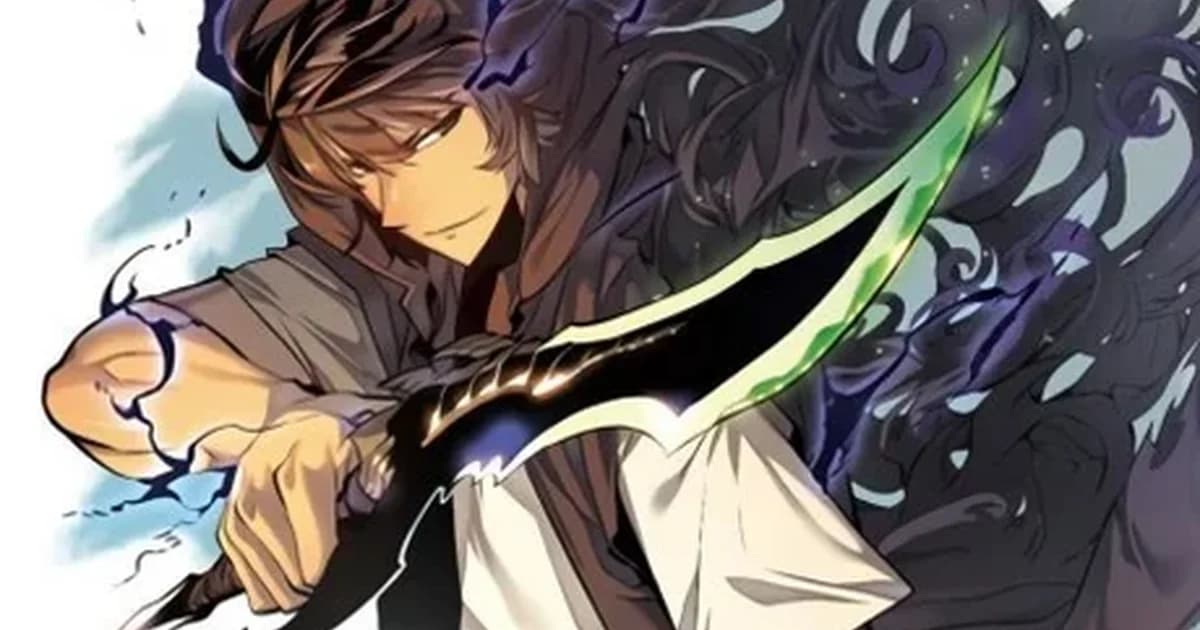
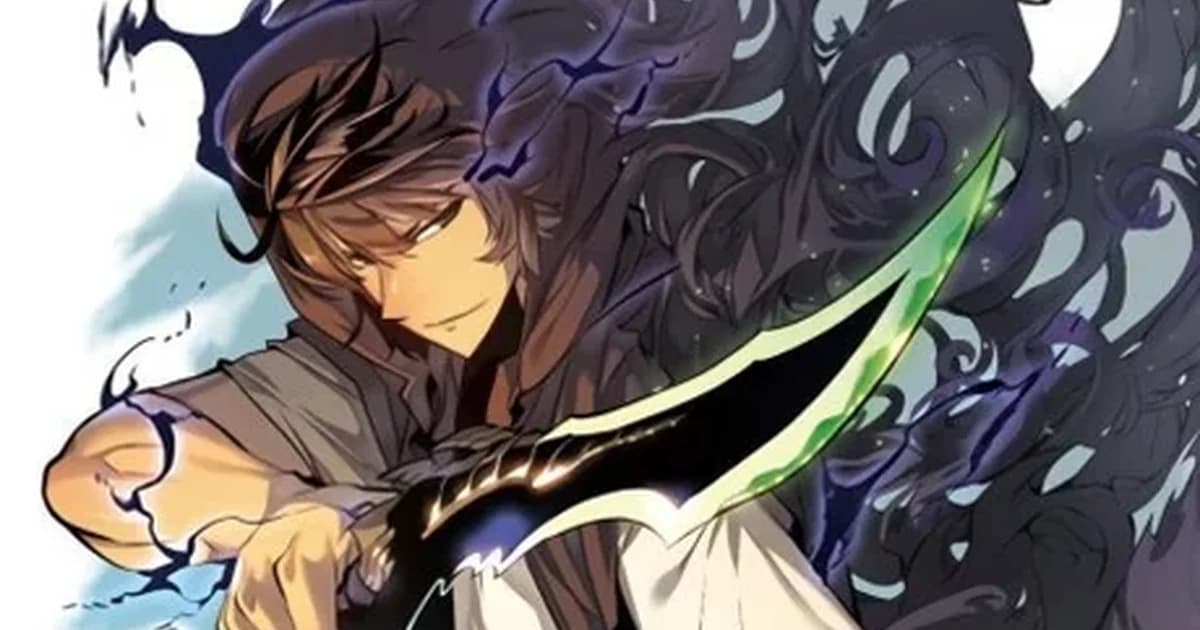
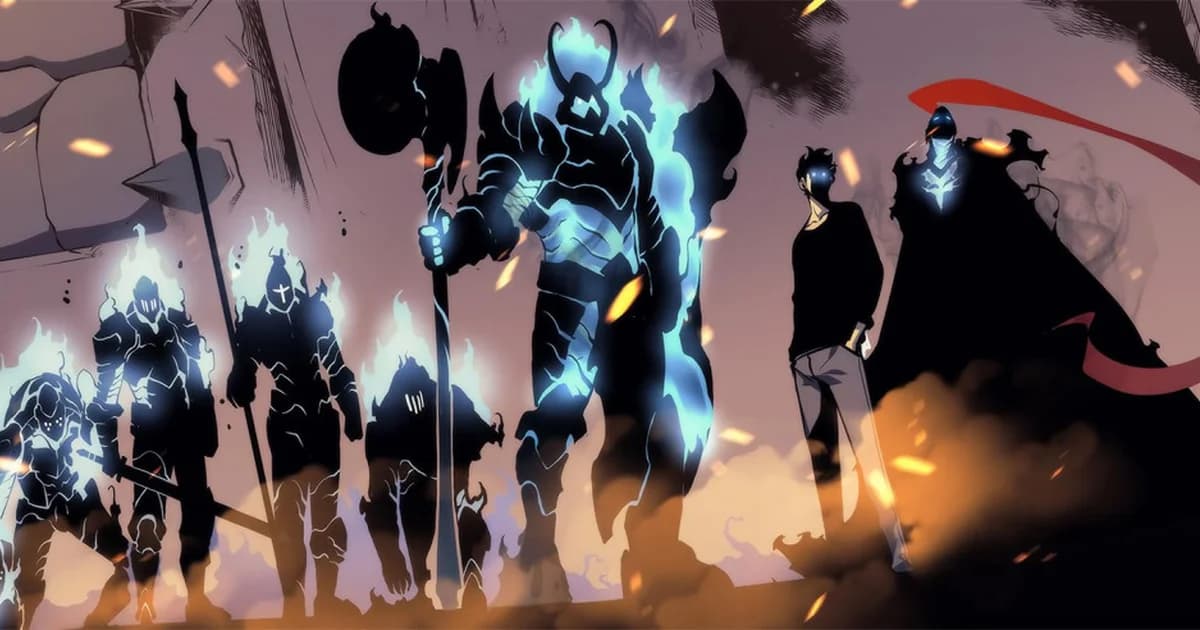
A-1 Pictures treats the manhwa's visual language (the shadow army's black armor and hollow eyes, the blue system-window UI, dungeon lighting built around hard contrast) as a spec to hit rather than a loose suggestion. Fight blocking translates cleanly into motion: shadow extraction sequences get held frames on the moment of extraction instead of a quick cut away, and the show rarely substitutes a static pan for actual animation during a fight. Across 25 episodes, off-model frames are rare enough that they don't register as a pattern, and that consistency matters more than any single standout shot. Holding a visual standard for a full cour is the harder trick.
Where the adaptation runs into trouble is pacing, specifically how much time Season 1 spends front-loading exposition before the shadow army mechanic starts paying off on screen. Season 1 compresses the manhwa's tutorial stretch and early dungeon-clearing chapters into twelve episodes, and the compression shows. But Why Tho?'s Kyle Foley credited A-1 Pictures with "a very distinct animation style" the studio had "perfected... over the years," while Creepy Kingdom's Sarah Musnicky flagged that the season "suffers a bit from pacing issues" even while calling it "an entertaining prologue." Both readings are fair at once. The animation itself never drops, but episodes 3 through 6 spend more screen time re-explaining the leveling system in dialogue than the manhwa needed to convey the same information across a handful of panels.
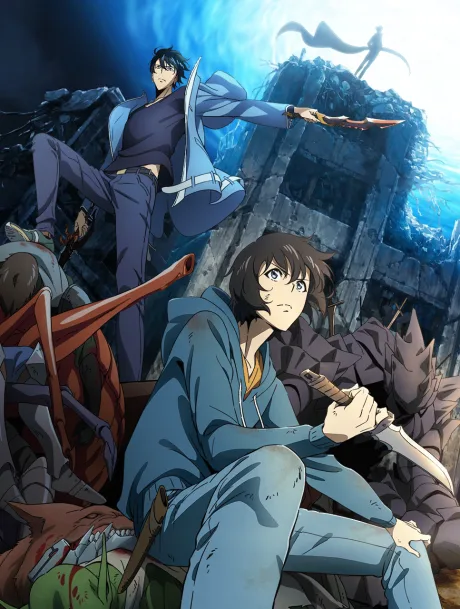 Official Season 1 key art. The blue-toned dungeon lighting and hard-contrast staging A-1 Pictures uses throughout the season is set here from the first promotional image. Source: AniList.
Season 2 corrects for it. Arise from the Shadow drops most of the recap instinct and commits to fight choreography earlier, which is the likely driver behind the AniList score climbing from 81 to 84 and the sharper turnaround in reader discussion once it aired. Jin-Woo's shadow extraction sequences read as the show's actual strength once the exposition clears out of the way: full-screen compositions, held frames on impact, none of Season 1's habit of cutting away before an attack lands. By the time Season 2 closes on the Jeju Island raid, Jin-Woo clearing level 100 and extracting the Ant King as his first General-rank shadow, the adaptation has finally found the register the manhwa hit several arcs earlier.
The adaptation's biggest weakness is inherited, not invented. Outside Cha Hae-In, the supporting cast exists mostly to react to Jin-Woo rather than develop independently, and episode-length compression makes that thinner instead of thicker. A character who gets a full chapter's introduction in the manhwa gets half an episode here, sometimes less. Go Gunhee and the Korean Hunters Association regulars register as names more than people by the Season 2 finale. Our manhwa review flags the same limitation in the source material itself, but a 24-minute episode format has less room to hide it than a 200-chapter completed run does.
Solo Leveling Anime Review: Rubric Assessment
Animation Quality
A-1 Pictures doesn't cut corners on the sequences that matter. Shadow extraction, dungeon-gate breaches, and the Jeju Island raid all get full animation budget: consistent character models, held frames on impact rather than static panning shots standing in for motion. Off-model frames are rare enough across 25 episodes that they never build into a pattern.

Pacing and Adaptation Fidelity
This is where the two seasons diverge most. Season 1 spends more screen time on system-window exposition than the manhwa spends on panel space explaining the same mechanics, and the compression from an unlimited-scroll format into a fixed 24-minute runtime shows specifically in episodes 3 through 6. Season 2 tightens the ratio of exposition to action considerably, and it's the more confident season for it. Neither season invents material the manhwa doesn't have. That matters: this isn't an adaptation padding its runtime with anime-original filler.
Voice Cast and Sound Design
Aleks Le and Taito Ban anchor Jin-Woo in English and Japanese respectively, and both performances scale convincingly as the character's power and confidence grow across the run. Hiroyuki Sawano's score is the single biggest production asset the anime has that the manhwa doesn't. "LEveL" (SawanoHiroyuki[nZk]:TOMORROW X TOGETHER) and "Reawaker" (LiSA featuring Felix of Stray Kids) both function as genuine needle-drops rather than incidental theme music.
Rewatch Value
Season 1 rewatches worse than Season 2. Once the system mechanics are established, the exposition-heavy stretch has less to offer a second time through. Season 2 holds up better because it's built around action sequences rather than explanation. The -ReAwakening- compilation film exists for viewers who want the Season 1 highlights without the exposition drag, though its theatrical-only release means it's harder to track down than either TV season.
Solo Leveling Anime Review Verdict
Advertisement
The Good
- A-1 Pictures' shadow army and Jeju Island raid sequences hit full animation budget with no visible mid-season drop across all 25 episodes
- Season 2 measurably fixes Season 1's pacing problem, reflected directly in the AniList score climbing from 81 to 84
- Hiroyuki Sawano's score and the SawanoHiroyuki[nZk] and LiSA/Felix of Stray Kids theme songs function as real storytelling, not filler
- Rotten Tomatoes' 100% critic score (9 reviews) and MyAnimeList's 8.14 rating both track with what's actually on screen
The Cons
- Season 1 episodes 3 through 6 over-explain the system mechanics in dialogue the manhwa conveyed visually in a handful of panels
- The supporting cast's thinness, inherited from the source material, gets worse under episode-length compression
- No confirmed Season 3 date. The anime currently stops around the Jeju Island raid, well short of the completed 200-chapter manhwa
This Solo Leveling anime review comes down to sequencing more than a single number. For viewers deciding whether to watch or read first: start with Season 1 and 2 if the draw is Sawano's score and A-1 Pictures' fight choreography, then switch to the manhwa once you hit the Jeju Island raid. That's roughly where the anime currently stops, and the completed 200-chapter run keeps going from there. Readers who've already finished the manhwa and want the specific arc-by-arc breakdown for catching the anime up, or for skipping ahead, should check our Solo Leveling reading guide.
Rating: 8.0/10
Frequently Asked Questions
Is the Solo Leveling anime worth watching?
That's the question this Solo Leveling anime review keeps circling back to, and the answer is yes, especially Season 2. A-1 Pictures' animation budget holds steady across all 25 episodes, Hiroyuki Sawano's score is doing more heavy lifting than most seasonal action shows get, and Rotten Tomatoes' critics gave Season 1 a 100% score despite its slower start. Season 1's first six episodes over-explain the system mechanics; push through them and the show gets noticeably better.
How many episodes does the Solo Leveling anime have?
25 episodes across two seasons. Season 1 ran 12 episodes from January 7 to March 31, 2024. Season 2, subtitled Arise from the Shadow, ran 13 episodes from January 5 to March 30, 2025. A theatrical compilation film, Solo Leveling -ReAwakening-, released between the seasons on November 29, 2024.
What chapters of the manhwa does the Solo Leveling anime cover?
Roughly the first half of the completed 200-chapter run. Season 2 closes on the Jeju Island raid, with Jin-Woo clearing level 100 and extracting the Ant King as his first General-rank shadow. For the full chapter-by-chapter breakdown and where to pick up the manhwa from there, see our Solo Leveling reading guide.
Does this Solo Leveling anime review cover the dub or the sub?
Both. Aleks Le's English dub and Taito Ban's Japanese original are discussed above under Voice Cast and Sound Design; neither performance misreads the character, and the choice between them comes down to preference rather than quality.
Who voices Sung Jin-Woo in the Solo Leveling anime?
Aleks Le voices Jin-Woo in the English Crunchyroll dub. Taito Ban voices him in the original Japanese version. Reina Ueda voices Cha Hae-In in Japanese; Michelle Rojas voices her in English.
Is there a Solo Leveling anime movie?
Yes, two. Solo Leveling -ReAwakening-, a 114-minute theatrical compilation film covering Season 1, released in Japan on November 29, 2024. A second film, Solo Leveling: Beyond the System, was announced at Anime Expo 2026 as an original story bridging Season 2 into Season 3, with no release date yet.
When is Solo Leveling season 3 coming out?
No release date is confirmed. D&C Media's investor materials place it in a 2027-2028 window. Full details are in our Solo Leveling season 3 release date tracker.
Should I watch the Solo Leveling anime or read the manhwa first?
Either works as an entry point. The anime is the faster, more expensive-looking introduction but currently stops around the Jeju Island raid. The manhwa is the complete 200-chapter story with sharper pacing throughout, and our Solo Leveling review covers that verdict on its own terms.
Related Reading
- Solo Leveling Review: The manhwa verdict, 8.5/10, covering DUBU's art and the completed 200-chapter run.
- Solo Leveling Reading Guide: Arc-by-arc chapter breakdown, including exactly where the anime's Season 2 leaves off.
- Solo Leveling Season 3 Release Date: What's confirmed about Season 3 and the Beyond the System bridge film.
- Manhwa Like Solo Leveling: Seven picks for readers who want the dungeon-hunter power climb in different forms.
- Solo Leveling Characters: Every Hunter and Shadow Ranked: the full cast sorted by role, from Jin-Woo's inner circle to the named Shadow Army and the Monarchs.
- Solo Leveling Live Action K-Drama: the confirmed Netflix announcement and the unconfirmed production details.