Loading…


ChapterBrief · Reviews
Sweet Home Manhwa Review: Why the Webtoon Beats Netflix
Sweet Home manhwa review: 8.8/10, completed 141 chapters. Kim Carnby's psychological horror and Cha Hyun-su's unusual arc make it better than Netflix.

Reviewing
Sweet Home
Kim Carnby (story), Hwang Young-chan (art) · WEBTOON
8.8
Score
8.8/ 10
WEBTOON
Pros
- The inner-monster mechanic ties each transformation to the character's specific psychology, not generic creature design
- Cha Hyun-su's suicidal starting point gives the survival horror genuine stakes: he does not want to survive
- Hwang Young-chan's art uses darkness architecturally, with every shadow placement made as a deliberate choice
- Completed in 141 chapters with a definitive ending, which the Netflix series cannot offer
- Kim Carnby's ensemble cast earns their deaths in ways most horror series do not bother with
Cons
- Several ensemble characters do not get enough space before their arcs resolve
- The finale chapters compress fast enough that some readers find the payoffs rushed
- Netflix familiarity may set wrong expectations: the show's later seasons go places the manhwa does not
Verdict
The best psychological horror manhwa available in English. The inner-monster mechanic, Hyun-su's unusual psychology, and Hwang Young-chan's art combine into something the Netflix adaptation only approximated in its first season.
This Sweet Home manhwa review starts with the detail most coverage skips: Cha Hyun-su had already decided to die. The story opens one week before his planned suicide. The apartment building where the series unfolds is not a destination he chose. It is where he ended up after his family was killed, a place to wait until he could finish what he had started.
TL;DR: Sweet Home manhwa review: 8.8/10. Kim Carnby's psychological horror uses the monster-transformation mechanic to examine desire and survival through a protagonist who started the story wanting to die. Hwang Young-chan's art is architectural and deliberate. Completed in 141 chapters. The Netflix adaptation follows it closely through Season 1, then goes elsewhere.
That starting point changes what the monster apocalypse means. For every other character trapped in Greenhorn Apartments, survival is the goal. For Hyun-su, survival was not part of the plan.
Key Takeaways
- Sweet Home manhwa review: 8.8/10, the best psychological horror manhwa available in English
- Written by Kim Carnby, art by Hwang Young-chan, 141 chapters, completed July 2020 on Naver (English WEBTOON version closed September 2020)
- Cha Hyun-su's desire-based transformation makes him the most unusual protagonist in the horror genre
- The Netflix adaptation follows the manhwa closely through Season 1, then goes its own direction entirely
- Recommended for readers who want completed manhwa with real psychological depth
Sweet Home Manhwa Review: The Setup That Changes Everything
The premise looks familiar from the outside: a monster apocalypse confines strangers in a building. They have to survive. Some turn into creatures, others fight back, and the cast narrows episode by episode.
What separates Sweet Home is the rule governing the transformations. People don't turn into random monsters. They become the physical expression of their strongest desire. The soldier becomes something built for violence. The gym-obsessed tenant becomes a muscle horror that can't fit through doorways. The mechanic is almost satirical in its directness, and it would read that way if Kim Carnby applied it lightly.
He doesn't. The transformation rule is the series' lens for examining who these people are at their least guarded. The desire isn't who they want to be. It's the thing they want most, the thing they may not have admitted to themselves, made visible and external and dangerous.
For a chapter-by-chapter breakdown of where to read and how the story is structured, the Sweet Home reading guide covers the full 141-chapter run. This review focuses on whether the series is worth the commitment.
The Monster Mechanic: Why Hyun-su Is Different From Every Survivor
Advertisement
Here is where the Sweet Home manhwa review needs to make something explicit that most coverage handles loosely.
Cha Hyun-su's dominant desire is his own death. That is what the week before the apocalypse had been building toward. When the transformation process reaches for his dominant desire, it finds something it cannot easily crystallize into a specific creature shape. His want is abstract, not directed at any external object. He wants to stop existing.
That ambiguity gives him unusual resistance to full transformation. A desire for a specific thing produces a monster shaped around that thing. A desire for annihilation has no shape. Hyun-su's inner voice, the darker version of himself he hears throughout the series, doesn't want to hunt or fight or grow. It wants them both gone.
The series runs that conflict across all 141 chapters without resolving it cheaply. Hyun-su doesn't find a reason to live because the plot decides he should. He builds something worth keeping, chapter by chapter, through connections he wasn't planning to make. It's never complete and never certain.
Kim Carnby also wrote the Bastard manhwa, another series where a character is trapped in a situation they did not choose, unable to act on the values they hold. The psychological signature is recognizable across both works: a protagonist who wants something decent in a context that makes decency almost structurally impossible.
Art and Atmosphere: Hwang Young-chan's Visual Horror
Hwang Young-chan's art is the reason Sweet Home can carry the tonal weight it carries. The color palette runs dark at every opportunity, not as stylization but as a choice about what the building's light sources are actually doing to the characters inside.
The monster designs deserve specific attention. Because each creature reflects a desire, the designs are grotesque in a specific body-horror direction rather than the generalized large-and-threatening aesthetic most horror reaches for. The muscle horror isn't just big. It's what happens when a human body is pushed past every structural limit by something the body itself generates. The proportions are wrong in ways that register as wrong, not simply alien.
Panel composition works the cramped apartment setting across all 141 chapters without becoming monotonous. The corridors, stairwells, and locked rooms create a visual grammar the series establishes early and then exploits in the later arcs when the building itself stops being structurally reliable.
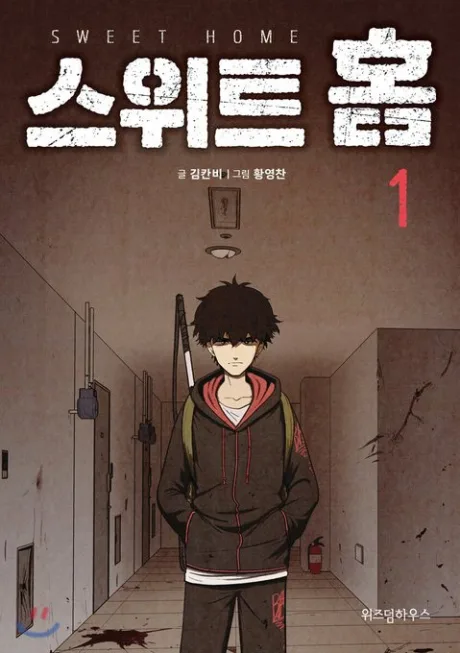 The cover gives the clearest read on Hwang Young-chan's visual language before you're 30 chapters in.
Story Pacing and the Ensemble Cast
One honest mark against Sweet Home is that the ensemble is large enough that not every arc gets the space it was building toward. The group that forms in the apartment has genuine personalities and distinct dynamics, and Kim Carnby is good at making their deaths land with weight. Some arcs still resolve faster than they were built, and the middle section carries more characters than it can give proper time to.
This is a real tradeoff. Sweet Home is 141 chapters and it knows how to pace a genre story. The building pressure of the early sections stays consistent across the first half. The back half accelerates and compresses, and whether that works depends on whether the ensemble resolution mattered to you or whether the Hyun-su arc alone is sufficient payoff.
The character that gets closest to matching Hyun-su's development is Eun-Hyuk, the cold-logic strategist who manages group resources and makes the calculations others refuse to make. His arc is among the series' best, and it resolves in a way that recontextualizes his role from the first chapters. Sweet Home is capable of that kind of payoff. The ensemble would have been stronger if more characters had received the same treatment.
For more completed manhwa that hold up across their full run, see the ranked list.
Best Completed Manhwa →
Sweet Home vs the Netflix Adaptation
Netflix Season 1 follows the manhwa's first arc closely. The apartment setting, the core cast, and the transformation rules translate to live action with adjustments that mostly improve pacing. Season 1 is a faithful adaptation.
Seasons 2 and 3 diverge, and I mean that literally. Netflix took the mythology somewhere the manhwa doesn't go and kept Hyun-su in a conflict the source material had already closed out. It's not bad, but it's a different story. Whether that's satisfying depends on whether you came for the characters or for the specific things Kim Carnby was saying with them.
The manhwa's ending is contained. The epilogue resolves Hyun-su's arc in a way the Netflix runtime couldn't have supported without additional hours. For readers coming from the show, it'll feel quiet. That quiet is intentional and earned.
Sweet Home Manhwa Review: Verdict
Advertisement
Sweet Home is an 8.8/10. The inner-monster mechanic isn't a gimmick. It's a tool for character analysis the series uses consistently across all 141 chapters. Hwang Young-chan's art is doing real work throughout. Cha Hyun-su is one of the rare horror protagonists who genuinely doesn't want to survive, and the series doesn't squander that.
The Good
- The inner-monster mechanic ties each transformation to specific psychology, not generic creature design
- Cha Hyun-su's suicidal starting point gives the survival horror stakes most genre entries don't have
- Hwang Young-chan's art uses darkness architecturally , every shadow is a deliberate compositional choice
- Completed in 141 chapters with a definitive ending the Netflix series can't offer
- Kim Carnby's ensemble cast earns their deaths rather than using them as filler
The Cons
- Several ensemble characters resolve faster than their setup deserved
- The finale chapters compress at a pace some readers will find rushed
- Netflix familiarity may set wrong expectations , the show's later seasons go places the manhwa doesn't
The two demerits are real: some ensemble characters don't get the resolution they deserved, and the finale compresses in ways that will frustrate readers invested in the full group. Against what the series gets right, those are manageable.
If you have already watched the Netflix series, read the manhwa regardless. Season 1 told you what the story is about. The manhwa tells you why it works. For more completed series in this range of quality, the best completed manhwa list covers the full landscape.
Related Reading
- Sweet Home Reading Guide: All 141 Chapters, Complete: How to read the full run and where Netflix diverges from the source
- Bastard Manhwa Review: Kim Carnby's other major series, tighter and more personal
- Best Manhwa Psychological Thriller: Completed and ongoing series for readers who want psychological depth
- Manhwa Like Sweet Home: Series with comparable horror tone and ensemble casts
- Sweet Home Character Guide: Every named survivor and antagonist, verified
Frequently Asked Questions
Is the Sweet Home manhwa completed?
Yes. Sweet Home ran for 141 chapters on WEBTOON and Naver, completing on July 2, 2020. The entire story is available to read in full, which makes it unusual among popular manhwa.
How many chapters does Sweet Home manhwa have?
141 chapters total, including a prologue and an epilogue. The English WEBTOON release began in January 2018 and finished in September 2020. Each chapter is listed as an episode on the WEBTOON platform.
Is the Sweet Home manhwa better than the Netflix show?
The manhwa is more focused. Netflix Season 1 follows the source material closely and is strong. Seasons 2 and 3 invent storylines beyond the manhwa's scope. If you want the complete story as Kim Carnby wrote it, the manhwa is the version to read.
What is the inner monster in Sweet Home manhwa?
Each character in Sweet Home begins transforming into a creature that reflects their dominant desire. Cha Hyun-su's desire is abstract, specifically his wish to die, which gives him unusual resistance to full transformation. His inner voice represents that darker impulse fighting for control throughout the series.
Who wrote and drew Sweet Home webtoon?
Kim Carnby wrote the story and Hwang Young-chan drew the art. Kim Carnby is also the author of Bastard, Pigpen, and Shotgun Boy. Hwang Young-chan's visual style is darker and more atmospheric than most manhwa from the same period.
Does Sweet Home manhwa have a good ending?
The ending is intentional and thematically consistent, though some readers find it abrupt. The chapter 140 epilogue resolves Hyun-su's arc with a quiet restraint that contrasts with the chaos of the final stretch. Whether it satisfies depends on what you needed the series to answer.
References
About the author

Critical Theorist & Features Writer
Manhwa and webcomic critic with a background in literary analysis. Writing about narrative and genre since 2016. Specialises in genre history and story structure.
- Manhwa and webcomic critic since 2016
- Graduate background in comparative literature
- Published criticism covering Korean and Japanese comics
- Specializes in genre lineage and narrative structure


Disclaimer
This article is published for informational and entertainment purposes. It does not constitute professional financial, legal, or technical advice. Series availability, platform access, translation status, and chapter counts change. Verify critical details (pricing, regional availability, official translation status) with publishers and platforms. Affiliate links, where present, help support our editorial work and are labelled in our affiliate disclosure.
Comments
Loading comments…