
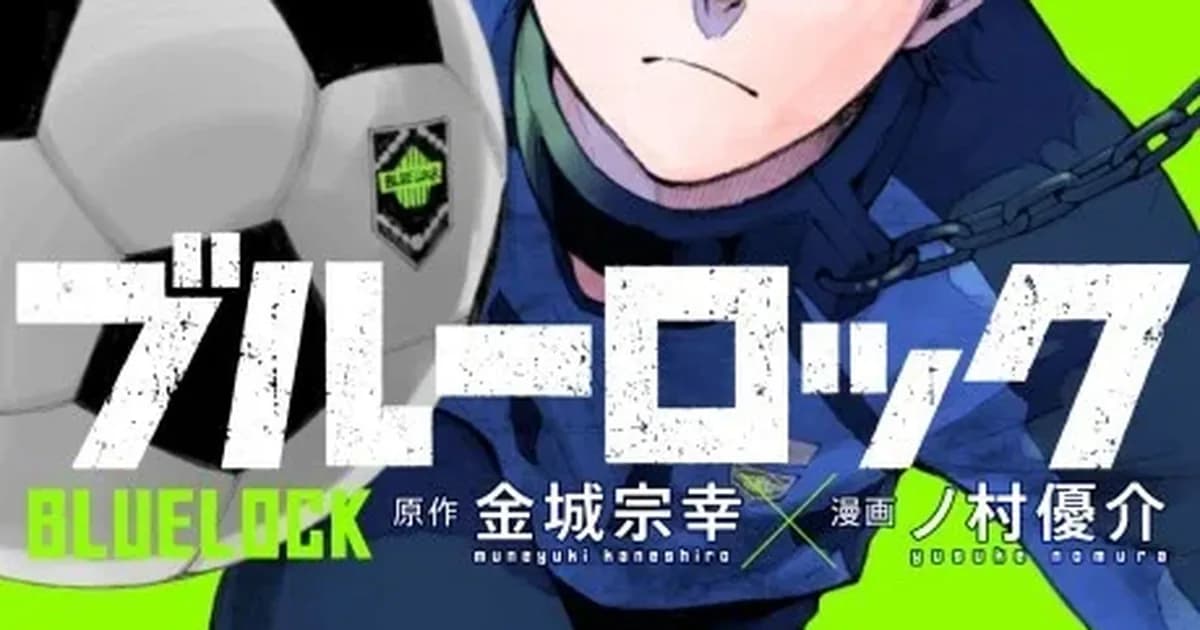
Blue Lock review, starting with a number that matters: 10.52 million copies sold in Japan in 2023, making it the best-selling manga of the year. For context, this is a manga about soccer, and Japan is not a country with a deep soccer reading tradition. That number tells you something about what the series got right.
TL;DR: Blue Lock review: 8.5/10. The first 108-chapter facility arc is exceptional; later material is more uneven. The manga is ongoing past 360 chapters, and Season 3 is confirmed with no official release date announced yet.
Blue Lock review: key takeaways
- Blue Lock review: 360+ chapters, ongoing weekly in Weekly Shōnen Magazine
- Rating: 8.5/10 (first arc is close to perfect; second arc weaker)
- Story by Muneyuki Kaneshiro, art by Yusuke Nomura (Kodansha)
- English via K Manga and Viz Media; physical volumes available
- Anime: Season 1 (Oct 2022), Season 2 (Oct 2024, animation issues), Season 3 confirmed with no official release date yet
- The ego philosophy is a structural argument, not a marketing hook
Overview
Three hundred elite high school strikers are selected for a national experiment. Only one will emerge as Japan's best striker. The rest are banned from the national team forever.
Jinpachi Ego runs the facility. He is not a conventional coach. His argument: Japanese soccer's commitment to teamwork and group harmony is the reason Japan cannot produce a world-class striker. The players who can win at the World Cup level are egoists. They score for themselves first. Teams win because the best player chose to play for them.
Blue Lock is the experiment to produce that player. The three hundred strikers are not teammates. They're competition for each other and for the slots above them. They will take one another's positions, eliminate careers, and destroy confidence. The one who survives is supposed to be the striker Ego's philosophy predicted was possible.
Isagi Yoichi, the protagonist, is not physically exceptional. He is not the fastest or strongest player in the facility. What he has is "metavision", a spatial awareness that lets him read where everyone on the field will be, where the ball needs to go, and what the defensive gaps are before they open. This is a cognitive gift, not a physical superpower. It makes Isagi unusual among sports manga protagonists, most of whom are defined by some natural athletic ability.
What Makes It Different
Advertisement
Standard sports manga structure: underdog with raw talent → mentor reveals hidden gifts → grinding improvement → tournament arc → team wins through friendship and perseverance.
Blue Lock breaks every part of this. There is no team to root for in the traditional sense. The mentor is an ideologue trying to produce something the conventional sports world claims doesn't exist. The grinding happens against rivals who are explicitly trying to dismantle your ability to continue. And friendship, when it appears, is transactional: two players' abilities currently complement each other, not because they like one another.
What drives the series is the philosophical argument itself. Ego might be right. The series never fully commits to validating him or discrediting him. Individual moments cut both ways: scenes where collectivism wins, scenes where it doesn't. The tension between these is the actual content.
The 2022-2023 World Cup timing helped: the series ran during a cycle when Japanese soccer was genuinely competing at the tournament level, and the argument about whether Japan's soccer culture held it back was a real discussion. Blue Lock arrived with an opinion on that debate.
Where Blue Lock fits against other top action and sports series:
Best Action Manhwa 2026 →
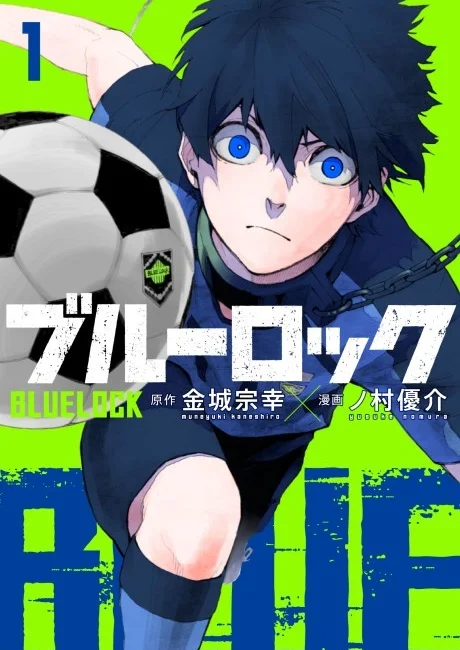 Blue Lock by Muneyuki Kaneshiro and Yusuke Nomura, the ego-driven soccer manga that redefined sports manga pacing.
Story Structure
The first arc (roughly chapters 1 through 108, equivalent to anime Season 1's 24 episodes) is the strongest material. Inside the Blue Lock facility, stakes are clear: every match eliminates someone. Progression is visible. You know exactly what Isagi is working toward and what he loses if he fails. Nomura's art in enclosed spaces does things with panel composition that suit the material precisely.
From chapter 109 onward, Blue Lock expands into professional and international play. This is where the structural problem appears. The facility gave the story a controlled environment where Ego's philosophy could be tested under clean conditions. In the professional leagues, the philosophical argument still drives the narrative, but the containment is gone. Characters who were vivid inside Blue Lock become scenery. The urgency of the first arc (the feeling that anyone could be eliminated at any point) doesn't translate to the open structure of professional competition.
The second arc is still worth reading if you're invested in the premise. It extends the argument into new territory and introduces new characters worth tracking. But it doesn't match what came before, and that gap is real enough to factor into the rating.
Blue Lock characters: the ones who matter
Three hundred strikers means most of them stay background. The ones the story actually follows are fewer, and they're worth tracking from early on.
Isagi Yoichi is the protagonist, and his gift is metavision: the ability to read every player's position and calculate where the ball needs to go before the defensive gap opens. He is not physically special. What he can do is process information about the field faster than players who outclass him athletically. This cognitive framing is what makes Blue Lock unusual, Isagi's development is about learning to trust and extend that awareness, not about training his body harder.
Rin Itoshi is the closest thing the series has to a rival worth the name. Unlike Isagi, Rin's talent is physical and technical: he is simply better at soccer than almost everyone in the facility. His motivation is personal in a way the series slowly reveals, and his relationship with Isagi across the second and third arcs carries the emotional weight the facility arc built on competitive respect. Readers who feel the second arc loses direction often find that Rin's presence is what holds the later material together.
Bachira Meguru is the most overtly imaginative player in the facility, his style is improvisational, built around instinct and unexpected movement. His arc in the first half is about whether pure creativity can survive an environment designed to optimize it out. He's also the character the series uses to test whether emotional connection and competitive purpose can coexist under Ego's framework.
Nagi Seishiro is introduced as someone who doesn't particularly want to play soccer and turns out to be a technical savant who simply hasn't been interested enough to develop consistently. His trajectory is the series' most deliberate challenge to Ego's thesis about motivation and genius.
Kunigami Rensuke represents the archetype the series is consciously working against: the team-first striker who plays for collective rather than individual glory. His arc is the harshest test the facility puts to Ego's hypothesis, and readers who found the second arc's treatment of him divisive are not wrong to, the series makes a real narrative bet with that storyline.
Arc structure: chapter ranges and what each covers
Arc 1, The Blue Lock Facility (chapters 1, 108, anime Season 1) The selection program. Players are organized into ranked teams and must defeat higher-ranked opponents to advance and take their spots. This arc has the tightest narrative logic in the series: every match eliminates someone, and the stakes are concrete. The five stages inside the facility each introduce new rules that force Isagi to develop his metavision beyond its initial form. This is where the philosophy gets its clearest test, contained, observable, high-stakes.
Arc 2, U-20 World Cup Training Camp and Overseas (chapters 109, 212, anime Season 2) The Blue Lock graduates compete in a test match against Japan's official U-20 national team, then move into professional and overseas contracts. The open structure loses the facility's containment. The best moments involve Rin and Isagi's evolving dynamic; the weakest are the overseas sub-plots that extend the arc's length without matching its density. Season 2's animation issues hit this material hard.
Arc 3, Neo Egoist League (chapters 213, present, covers Season 3 material) The major professional league in Blue Lock's version of Japanese football. The Neo Egoist League is the arena where Ego's experiment gets its fullest real-world test: players who were conditioned by the facility now competing in a structure that rewards results, not philosophy. This arc reintroduces earlier characters in changed forms and raises the question of whether what Blue Lock produced is sustainable beyond the laboratory conditions.
Season 3 will cover this material, but its release date and episode count have not been announced. Based on arc length and pacing comparisons with the first two seasons, it could reach somewhere in the 215-240 chapter range.
Art & Story
Yusuke Nomura's work makes soccer's spatial logic visually clear in a way that most sports manga doesn't manage. In any given key sequence, you can trace exactly where every player is on the field, what Isagi is reading, and where the gap will open. This is hard to do in a static medium with a sport as positionally complex as soccer. Nomura does it consistently.
Character design handles the harder problem: distinguishing three hundred young male athletes from each other when most of them have similar baseline builds. Nomura solves this through silhouette variety, face structure, and styling choices that stick in memory. Characters you last saw forty chapters ago remain recognizable when they return.
The manga's panel pacing is tighter than the anime adaptations, particularly in the facility arc. Key sequence moments in chapters 40-80, Isagi's first activation of metavision in a high-stakes context, the confrontation matches in Stage 4, are structured in ways that the anime expanded but didn't improve. If you watched Season 1 and found certain sequences blurry in memory, the manga originals are worth reading for those specific chapters.
Anime vs. Manga
Season 1 (October 2022-March 2023, 24 episodes, Eight Bit studio) is a good adaptation. The pacing is tight, the animation holds up for the key sequences, and the facility's spatial logic translates well. If you want a preview of whether the first arc is for you, Season 1 works.
Season 2 (October-December 2024, 14 episodes) has problems. Animation degrades from episode 2 onward: rough frames, static panning shots covering for production limitations, ball physics that don't hold up to the first season's standard. The material covered is important for the ongoing story, but the manga version of those chapters is the better experience.
Season 3 is confirmed with Eight Bit returning, but no official release date has been announced. Whether the studio has addressed the Season 2 production issues is the key question going in. The material for Season 3 (the Neo Egoist League arc) is strong, and it deserves a better visual presentation than Season 2 managed.
Full reading order and where to start in English:
Blue Lock Reading Guide →
 Blue Lock's interior art prioritizes psychological tension over physical realism, panels feel like game theory.
Is Blue Lock worth reading if you've watched the anime?
The answer depends on which season you finished and how much the animation quality bothered you.
Season 1 (24 episodes, October 2022-March 2023, Eight Bit) is a faithful adaptation of chapters 1-108. The pacing holds, the facility's spatial logic translates well to animation, and the key sequences -- Isagi's first metavision activation, the Stage 4 confrontations, the final facility matches -- are well-executed. If you finished Season 1, you've effectively read the first arc. There's no meaningful gap between the two versions of this material.
Season 2 (14 episodes, October-December 2024) covers chapters 109-212 and has real production problems. Rough frames, static panning shots substituting for animated sequences, ball physics that don't match Season 1's standard. The material it adapts -- the U-20 match, the overseas arcs, the Rin backstory -- is important for the ongoing story, but the manga version reads more clearly. If Season 2's animation frustrated you, chapters 109-212 in manga are worth going back to.
Beyond chapter 212: Season 3 is confirmed but hasn't aired yet, and its release date is unannounced. Everything in the Neo Egoist League arc (chapter 213 onward) is currently manga-only. Readers who watched both anime seasons and want to know what happens next have no option except the manga.
The practical reading path: finish anime S1 and S2, then start manga at chapter 213. If S2's animation bothered you, back up to chapter 109 and read through from there.
Blue Lock Season 3: What the Anime Will Cover
Season 3 is confirmed with Eight Bit returning as the studio, but no official release date has been announced. This is the most active search question around the series right now, so here's what's confirmed and what's still unknown.
What arc does Season 3 adapt?
Season 3 covers the Neo Egoist League (NEL) arc, which starts at approximately chapter 213. The NEL is the major professional football league in Blue Lock's world, the first time the facility graduates compete in actual professional competition rather than a controlled elimination experiment. No more elimination rounds or explicit ranking numbers. The question the arc asks is whether what the facility produced holds up without the facility's scaffolding.
How many episodes will Season 3 have?
No official episode count has been confirmed. Season 1 ran 24 episodes for roughly 108 chapters. Season 2 ran 14 episodes for approximately 103 chapters. A comparable Season 3 would likely cover chapters 213 through somewhere in the 240s, though episode counts haven't been announced and the arc is ongoing.
Will Eight Bit fix the Season 2 animation problems?
No public statement from the studio on this. The NEL arc is visually more demanding than the facility arc, professional matches have larger-scale formations and more players on the field simultaneously. Whether Eight Bit addresses Season 2's rough frames and inconsistent ball physics is the major production question going in. The source material deserves better than what Season 2 delivered.
Should manga readers start with Season 3?
No. The NEL arc assumes full knowledge of the facility arc and the U-20 international material. Season 3 will not work as a standalone entry. If you want to be current before the third season airs: finish the manga from chapter 1, or start at chapter 213 if you've watched both prior seasons.
For readers already in the manga: the NEL arc extends well past where Season 3 will end, which means the manga stays ahead of the anime regardless of what the adaptation covers.
What about the live-action film?
Separate from the anime, a live-action film adaptation opened in Japan on August 7, 2026. Director Yusuke Taki leads the production, with Masataka Kubota cast as Jinpachi Ego and Fumiya Takahashi as Isagi. Toho is distributing nationally across approximately 350 theaters, with singer Ado performing the theme song "Monstruo." No international release date has been confirmed at this point. The film adapts the facility arc -- the same material covered by anime Season 1 -- making it the third screen adaptation of that section of the story alongside the Episode Nagi theatrical film (April 2024, anime).
The Blue Lock Facility: What the Experiment Actually Is
Blue Lock is not a sports manga about a team trying to win a tournament. It's a social experiment with a specific hypothesis: Japan cannot produce a world-class striker because Japanese sports culture systematically punishes the selfishness required to be one.
Ego Jinpachi's design for the facility reflects this hypothesis directly. Three hundred of Japan's best under-18 strikers enter. They are ranked from 1 to 300 based on Ego's assessment of their potential. Players ranked in the bottom half in each round are eliminated and permanently banned from Japan's national team. This is not a training program. It's a selection mechanism that operates by destroying the careers of everyone it doesn't produce.
The psychological design is specific. Players cannot form stable teams or alliances, because any teammate is also a competitor for the slots above them. The facility strips away the social framework that Japanese team sports rely on, forcing players to evaluate every situation through a single question: what does this moment require from me, specifically, to survive it? Ego's claim is that this question, asked consistently enough, is what produces a striker capable of deciding a match at the World Cup level.
What makes this interesting as a narrative setup is that it's a real argument. Not a cartoon villain's scheme, but a structured position on why collective harmony, taken as the highest value in a team sport, produces excellent systems and mediocre individuals. The facility is the test. The manga is the record of what the test actually reveals, and Kaneshiro is careful not to fully resolve the question in either direction.
Ego's Philosophy: Correct or Not?
Jinpachi Ego is not the villain of Blue Lock. He's the architect with a thesis, and the manga takes that thesis seriously enough to complicate it.
His core argument: Japanese football at the international level fails because it rewards what he calls "the good boy" mentality. Players who defer to teammates, who choose the pass over the shot, who subordinate their own instinct to collective harmony, are celebrated in domestic leagues. At the World Cup, this produces organized teams that generate chances and forwards who don't take them. Ego's position is that the striker who scores in a World Cup final is not thinking about his teammates in that moment. He's thinking about the goal.
The manga tests this. There are sequences where collective play beats the individual egoist. There are sequences where Isagi's metavision, which is fundamentally a tool for reading everyone else's position and exploiting it, looks less like selfishness and more like a highly specialized form of awareness. The series leaves room for both readings, and that tension is what keeps the philosophical argument from becoming propaganda for either position.
Ego's argument also connects to a real debate in Japanese sports culture. Japan's 2022 World Cup run (the series was running during this period) generated genuine discussion about whether Japan's team-first approach limited individual development. Blue Lock arrived with a strong opinion on that debate, and the timing sharpened how readers engaged with the premise.
Whether Ego is right is not fully answered by chapter 360. This is a feature, not a frustration.
Is Blue Lock manga finished? Ending rumors, checked
No. Blue Lock is ongoing as of September 2026: 360+ chapters, 39 collected volumes, serialized weekly in Kodansha's Weekly Shōnen Magazine since August 2018, with over 60 million copies in circulation. No ending has been announced by Kaneshiro, Nomura, or Kodansha.
The "final arc" rumors that circulate every few months come from a structural fact rather than any announcement: Blue Lock is one of the few long-running shonen whose ending is visible from chapter 1. The premise defines the endpoint. Ego's experiment exists to produce the striker who wins Japan the World Cup, so the series has to end at a World Cup, and every arc since the facility has moved the cast one step closer to international play. When readers see the story enter World-Cup-facing territory, "the ending is near" speculation follows automatically.
The math says otherwise. The Neo Egoist League arc alone has run well over 100 chapters. A full international tournament, staged at Blue Lock's usual match pacing (a single match regularly spans 10 to 15 chapters), is years of weekly serialization, not months. Nothing in the publication pattern suggests a wrap-up: no accelerated pacing, no compressed matches, no farewell messaging in volume afterwords.
What a confirmed ending would look like, when it comes: Weekly Shōnen Magazine titles typically announce a final arc formally in the magazine itself, the way Kodansha handled its other long-runners. Until that announcement exists, treat any "Blue Lock ending confirmed" headline as speculation. This section will be updated when the status changes.
Blue Lock in 2026: where the story is
As of September 2026, Blue Lock is at 360+ chapters and deep into the Neo Egoist League arc.
The Neo Egoist League is the major professional competition in Blue Lock's version of Japanese football -- the arena where Ego's facility graduates compete in the actual sport, not a controlled elimination experiment. The structure is different: no elimination rounds, no explicit ranks, no single supervisor imposing the rules. What the arc tests is whether what the facility produced holds up without the facility's scaffolding.
The arc reintroduces characters from earlier arcs in changed forms. Some facility graduates landed professional contracts. Some didn't. Those outcomes aren't glossed over, and seeing where the facility's 300 players ended up reframes the earlier material in ways the facility arc itself couldn't show. Isagi and Rin's dynamic continues as the arc's emotional spine -- their relationship has the most accumulated weight by this point, and the Neo Egoist League gives it room to develop in a competitive context outside the facility's rules.
Season 3 will adapt the early portion of this arc, with Eight Bit returning as the studio. Based on pacing comparisons with S1 and S2, a 12-16 episode season would cover roughly chapters 213-240. The manga currently sits well past that point, which means the manga is the only path to the story's current status regardless of what Season 3 covers.
For readers who want to stay current: the manga is ahead of any adaptation that's aired or been announced.
Blue Lock vs Other Football Manga
Blue Lock is the psychological outlier in a genre with established traditions.
Captain Tsubasa (1981-ongoing) is the classical reference point: technical, idealistic, built around players with signature techniques and an underlying belief that football is a vehicle for individual dreams fulfilled through collective effort. Captain Tsubasa shaped a generation of actual Japanese footballers who cite it as their introduction to the sport. Blue Lock is, in some ways, a direct argument against what Captain Tsubasa represents.
Ao Ashi (2015-ongoing) sits at the opposite end of the realism spectrum. It follows a talented player entering the youth academy system and learning how to read the game tactically. The focus is on positional intelligence, formation work, and the gap between raw talent and professional-level football IQ. Readers who want realistic football process will find Ao Ashi closer to what they're looking for. Blue Lock's soccer is stylized around psychological confrontation, not tactical simulation.
Giant Killing (2007-ongoing) approaches the sport through management and team dynamics. The protagonist is a coach rebuilding a struggling club, and the series is interested in organizational psychology and how teams recover from losing cultures. No ego philosophy, no elimination format; the opposite orientation entirely.
Blue Lock's actual comparison class is not football manga at all. Its structure (elimination format, psychological pressure as the primary dramatic engine, protagonist whose gift is cognitive rather than physical) is closer to psychological thrillers or competitive game manga like Hikaru no Go or Liar Game than to Captain Tsubasa or Ao Ashi. Readers who bounced off tournament arcs in conventional sports manga may find Blue Lock works for them specifically because it's not operating in that tradition.
If that's the appeal -- the structured game system where winning by out-thinking the field matters more than raw talent -- see Manhwa Like Liar Game: 6 Picks for Game Thriller Fans for manhwa that run on the same mechanic.
Blue Lock review: verdict
The Good
- First arc (~108 chapters) is close to perfect as sports manga -- the elimination premise is a genuine structural argument, not just a tournament gimmick
- Isagi's metavision (the ability to model opponents' next moves spatially) is a cognitive gift, which makes him unusual for the genre -- his growth is about perception, not stamina or raw power
- Nomura's art makes soccer's spatial logic legible: you can follow where players are, what the sight lines are, why specific shots work
- Ego philosophy drives every narrative decision rather than being a one-chapter motivation speech and then dropped
- 10.52 million copies sold in Japan in 2023 -- best-selling manga of the year for a series about soccer in a country without a dominant soccer culture
The Cons
- Second arc (chapters 109-212) sidelines Bachira, Kunigami, and Nagi -- characters who defined the first arc's dynamics -- in favor of a bloated international stage
- Season 2 anime adaptation (Oct-Dec 2024, 14 episodes) had production problems throughout: rough frames, inconsistent ball physics, static panning in key sequences
- Neo Egoist League arc (chapter 213+) is still ongoing with no announced completion window
The first arc is close to perfect as sports manga. The premise is a genuine argument with structural consequences, Isagi is more interesting than most sports protagonists because his gift is cognitive rather than athletic, and Nomura's art serves the material's spatial demands. The 10.52 million copies in Japan in 2023 are not an accident.
The second arc is weaker -- the drop is real if you read straight through, but it doesn't invalidate what came before. If the first arc hooked you on the premise, the later material extends it into interesting territory even if it doesn't match the first arc's precision.
Read the manga rather than relying on the anime. Season 1 is a strong adaptation, but Nomura's panel compositions in the key sequences (particularly chapters 40-80) are worth experiencing directly. Start at Chapter 1, read through ~108, and then decide whether to continue.
Rating: 8.5/10
Frequently Asked Questions
Advertisement
Is Blue Lock worth reading?
Yes, especially the first arc (chapters 1-108). The ego premise is a genuine structural argument, Nomura's art is excellent, and Isagi is more unusual as a sports protagonist than most. The second arc is weaker but worth continuing once the first arc has you. Don't start with the anime Season 2, go back to chapter 1.
Is Blue Lock manga or manhwa?
Blue Lock is manga: Japanese, right-to-left, serialized in Weekly Shōnen Magazine by Kodansha. The site covers it because it belongs on any sports reading list alongside Korean manhwa, and it frequently comes up in manhwa recommendation threads.
Where can I read Blue Lock manga in English?
K Manga (Kodansha's official app) and Viz Media are the official English sources. Physical volumes are available from Kodansha USA starting 2022. Blue Lock is not on MANGA Plus, which is Shueisha's platform.
How many chapters is Blue Lock?
360+ chapters as of September 2026, ongoing weekly. The series is in its third major arc (Neo Egoist League). There is no announced completion date.
Is the Blue Lock anime good?
Season 1 (2022-23, 24 episodes) is a strong adaptation. Season 2 (Oct-Dec 2024, 14 episodes) had animation quality problems: rough frames from episode 2 onward, static panning shots, inconsistent ball physics. Season 3 is confirmed, but its release date is unannounced. The manga is the better experience for the later arcs.
Is the Blue Lock manga better than the anime?
For the first arc, both are strong. For the second arc and beyond, the manga is clearly better, the Season 2 anime had notable production problems. The panel compositions in key sequences (chapters 40-80 especially) are tighter than the anime's pacing. If you watched Season 1, going back to the manga from chapter 109 is a reasonable approach.
Blue Lock: Episode Nagi and the Spinoffs
Blue Lock: Episode Nagi is the franchise's main spinoff -- a parallel manga that covers the Blue Lock selection phases from Seishiro Nagi and Reo Mikage's perspective. It's not a sequel or prequel in the traditional sense. The events overlap with the main series; what changes is which characters you're tracking and what the story is paying attention to emotionally.
What it is
Written by Muneyuki Kaneshiro (the same writer as the main series) and illustrated by Kota Sannomiya, Episode Nagi ran in Bessatsu Shonen Magazine from June 9, 2022, to July 9, 2025. The series concluded at 36 chapters collected into 8 volumes -- a complete story rather than an ongoing series. Kodansha USA released the first English volume in October 2024, with the full 8-volume run now available in digital ($10.99 per volume on K Manga and Kodansha's platform) and print ($13.99 per volume at major retailers).
The premise: before Blue Lock, Seishiro Nagi was a technical savant who barely cared about soccer. Reo Mikage, a wealthy classmate with serious competitive ambitions, spent two years persuading Nagi that his instinct for the game was exceptional. Episode Nagi covers how that partnership formed, what it cost both of them when the facility's structure forced them into competition rather than collaboration, and what the Reo-Nagi dynamic actually was beneath the surface the main series provides.
Why it's worth reading if you care about Nagi
In the main series, Nagi is one of the more ambiguous figures: someone with extraordinary natural ability who became competitive at the facility for reasons the story doesn't fully explain. Episode Nagi is where those reasons live. Readers who found the main series' second arc treatment of Reo and Nagi incomplete -- specifically the moment where their partnership fractures -- will find the spinoff gives that fracture the weight the main series didn't take time to build.
The spinoff also received its own anime film adaptation, released in Japanese theaters on April 19, 2024, directed by Shunsuke Ishikawa. The film is a standalone watch and covers the same 36-chapter story in compressed form.
The verdict on the spinoff
Episode Nagi is not required before starting the main series, and you won't lose story threads by skipping it. Read it after the facility arc if Nagi's trajectory interested you during those chapters -- or after finishing both arcs if you want the Reo-Nagi dynamic filled in before the third season airs. Since the series is complete at 8 volumes, there's no ongoing wait.
Korean manhwa with competitive elimination formats and ego-driven protagonists:
Manhwa Like Blue Lock →
Related Reading
- Blue Lock Reading Guide: Reading order, season breakdown, and where to read legally in English.
- Manhwa Like Blue Lock: Korean manhwa with competitive structures, elimination pressure, and ego-driven protagonist energy similar to Blue Lock.
- Best Manhwa Tournament Arcs: Other series with high-stakes competition structures similar to Blue Lock's selection format.
- Best Manhwa to Read in 2026: Broader starter list for readers new to manhwa and manga with similar energy.