Loading…

ChapterBrief · Reviews
Surviving the Game as a Barbarian Review: Worth It?
Surviving the Game as a Barbarian review: 8.0/10. Veteran gamer trapped as an NPC barbarian. No cheat system, raw survival only. Ongoing on WEBTOON.

Reviewing
Surviving the Game as a Barbarian
MIDNIGHT STUDIO (story), Yungang Jeong (art) · WEBTOON
8.0
Score
8.0/ 10
WEBTOONTappytoon
Pros
- The barbarian class forces a survival approach that most isekai manhwa avoid, no system window, no magic skills, raw strength and player knowledge only
- Han-Su's nine years of game expertise functions as actual strategic content: he knows dungeon layouts, boss patterns, spawn rates, and exploits them specifically
- Art by Yungang Jeong handles brutal dungeon combat with visual clarity, barbarian combat is physically readable in a way that magic-based fights often aren't
- The reincarnation as an NPC rather than the protagonist creates structural comedy and genuine disadvantages that drive most of the story's conflicts
Cons
- Ongoing with no stated end point, the series started strong and pacing in later arcs can stretch what earlier chapters handled more efficiently
- The harem adjacent relationship dynamic in later arcs is less interesting than the survival problem-solving that distinguishes the early chapters
Verdict
Surviving the Game as a Barbarian earns its 8.0 by doing something most isekai manhwa won't: giving the protagonist a class that can't shortcut past survival. The game expertise provides strategy; the barbarian body provides strength; the combination is more interesting than either alone.
Surviving the Game as a Barbarian review: the premise is doing actual work here, not just providing a setup for a power fantasy.
TL;DR: Surviving the Game as a Barbarian review: 8.0/10. Portal isekai where a veteran gamer wakes up as a barbarian NPC instead of a player character. No magic system, no crafting skills, just raw strength and nine years of game knowledge. Ongoing on WEBTOON. Best for readers who want survival isekai with actual strategic content.
Han-Su Lee spent nine years mastering Dungeon and Stone, the VRMMO no player had ever cleared. When he finally reaches the final boss's dungeon entrance, the game pulls him in. He doesn't wake up as the protagonist. He doesn't get the hero class. He wakes up as a barbarian, an NPC class that other players will eventually encounter as an enemy mob.
That constraint is the series' best feature.
Rating: 8.0/10
Surviving the Game as a Barbarian review: key takeaways
- Rating: 8.0/10
- Status: Ongoing on WEBTOON
- Story: MIDNIGHT STUDIO. Art: Yungang Jeong
- AniList: 80/100, 18,368 users tracked, trending 6
- Platform: WEBTOON (English), Naver Webtoon (Korean)
What "barbarian class" actually means
Most isekai manhwa give the protagonist a class that compensates for being a stranger in a dangerous world. The hero class, the shadow monarch, the necromancer, whatever the mechanism, it provides power that other inhabitants don't have. The protagonist is unusual upward.
Han-Su's barbarian class is unusual downward. NPCs in Dungeon and Stone have fixed behaviors, limited item access, and no player interface. They can't use the store system. They can't communicate with other players as equals. They're monsters and mobs to everyone who entered the world as a player character.
What Han-Su has instead is nine years of game knowledge: dungeon layouts, boss movement patterns, safe zones, spawn timing, hidden item locations. The game world is genuinely dangerous, but he's dangerous in a specific way, the barbarian body provides raw strength, and the nine years of play provides the strategy.
The series does something smart early: it demonstrates that this knowledge has real limits. The world of Dungeon and Stone isn't the same as playing it. Weather conditions, hunger, exhaustion, things the game abstracted away, are real. Han-Su has to adapt expertise designed for a game interface to a world where interface shortcuts don't exist. The early chapters are a good-faith reckoning with what "game knowledge" means in actual survival conditions.
For another expert-navigates-hostile-world portal series:
Tomb Raider King Review →
Art & Story: brutal dungeon, readable combat
Advertisement
Yungang Jeong's art is particularly good at what the barbarian combat premise requires. Magic-based manhwa fights often become incomprehensible at high stakes, too many effect layers, too much particle noise. Barbarian combat is physical, which forces clarity.
Han-Su's fighting style communicates weight. The barbarian's size relative to standard opponents, the panel compositions during charge attacks, the visual difference between berserker-mode activations and standard combat, these are readable in a way that lets the reader track what's happening and why. For a series that relies on the reader understanding the strategic decisions, that clarity matters.
The dungeon environments are varied enough across the run to avoid visual monotony. Stone dungeons, forest zones, underground water sections, Jeong maintains distinct visual environments that serve as location memory for readers following the ongoing story. The character design for Han-Su as barbarian is distinctive: the proportions don't fit the standard manhwa protagonist aesthetic, which is appropriate and consistently maintained.
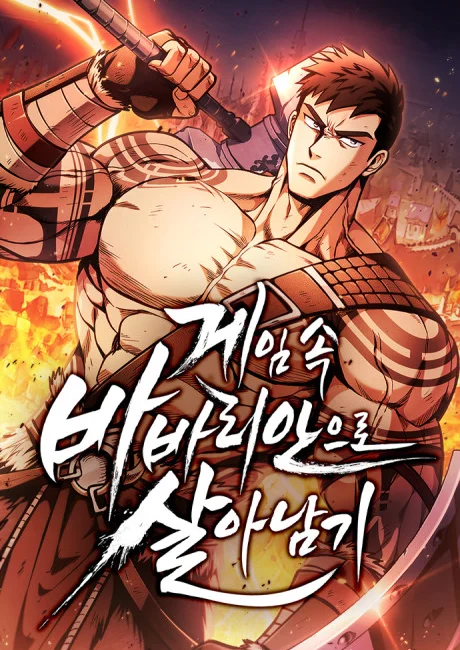 Surviving the Game as a Barbarian by MIDNIGHT STUDIO (story) and Yungang Jeong (art), ongoing on WEBTOON.
The NPC problem and other players
Other players exist in the same world and have player advantages. They can use the store interface, communicate via player systems, form guilds, access fast travel points. Han-Su can't do any of this. He can be recognized as a player by some NPCs who've been in the world long enough to notice the behavioral difference, but from every player's perspective, he's a barbarian NPC.
This creates the series' recurring structural tension. Han-Su knows more about the world than most players, he knows boss patterns they haven't discovered, shortcut routes they'll find later, event sequences that are about to trigger. But he can't communicate this knowledge through normal player channels. The ways he can put his expertise to use have to work within the NPC constraint.
The player-NPC dynamic is where the series distinguishes itself from standard isekai. It's not just "protagonist knows things." It's "protagonist knows things and can't use conventional tools to act on that knowledge, so he has to be creative." That problem drives most of the early arcs.
For comparison with a different approach to game-portal isekai, Overgeared Review covers a production class protagonist in a VRMMO, different class, different constraint, similar "expertise as the real advantage" structure.
Pacing and the ongoing caveat
The early chapters are tight. The survival problem is immediate, the game expertise is deployed specifically, and the NPC constraint creates genuine friction. Chapters 1, 50 are a sustained argument for the premise.
The later arcs relax the survival tension as Han-Su's strength and reputation develop. This is a natural progression, a protagonist who keeps failing to survive past chapter 100 isn't serving the genre, but the loosening also reduces the creative tension that made the early chapters distinctive. Some character dynamics that develop in the later arcs (notably relationship material) are less interesting than the problem-solving that distinguishes the series.
The ongoing status means this pattern hasn't resolved. Readers starting now will have more volume to judge, which is either a feature (more content) or a caveat (the series hasn't demonstrated it can sustain the early quality across a long run). The early arc quality is high enough that the ongoing commitment is reasonable.
For a completed portal manhwa with strategic acquisition mechanics:
Tomb Raider King Reading Guide →
The Tomb Raider King anime premieres July 8, 2026 -- if you've finished the manhwa and want to know what else to watch or read this summer, see Summer 2026 Anime for Manhwa Fans: What to Read Now.
Surviving the Game as a Barbarian review: verdict
Advertisement
The Good
- Barbarian class forces genuine survival problem-solving: no system shortcuts, no magic, raw strength plus player knowledge, the combination produces more interesting situations than a standard cheat skill
- Han-Su's nine years of expertise is deployed specifically and credibly: he knows boss patterns because he farmed them, not because the narrative needed him to
- Yungang Jeong's art handles physical combat with the clarity that magic-effect-heavy manhwa can't always manage; barbarian fights are readable at speed
- The NPC-vs-player dynamic creates recurring structural tension that goes beyond "protagonist is secretly powerful"
The Cons
- Ongoing with no stated end point, the later arcs show some loosening of the early survival tension as the protagonist's position in the world stabilizes
- Relationship material in the later chapters is less interesting than the survival problem-solving that defined the early run
Surviving the Game as a Barbarian is worth reading for readers who are tired of isekai protagonists who immediately get a convenient cheat. The barbarian premise is uncomfortable and the series commits to that discomfort long enough to demonstrate why the constraint produces better storytelling.
Start at chapter 1. The premise establishes quickly and the early arcs are the series' strongest argument for itself.
Rating: 8.0/10
Frequently Asked Questions
Is Surviving the Game as a Barbarian worth reading?
Yes, particularly if you're tired of isekai where the protagonist immediately gets a cheat skill. The barbarian class means survival requires actual strategy. AniList scores it 80/100.
How many chapters is it?
Ongoing on WEBTOON as of mid-2026. Check WEBTOON for the current episode count.
Where to read?
WEBTOON (English digital). Korean original on Naver Webtoon. Fast Pass for the newest episodes; older episodes free.
What class does the protagonist have?
Barbarian, an NPC class. No magic, no crafting system, no player interface. Raw strength plus nine years of game expertise.
Is it an isekai?
Yes, game-portal subgenre. Han-Su gets transported into a VRMMO he spent nine years playing, waking up as a barbarian NPC rather than a player character.
How does it compare to Tomb Raider King or The Beginning After the End?
All three use expertise to navigate a dangerous world. Tomb Raider King uses relic foreknowledge in a dungeon-hunter setting. TBATE uses past-life memory. Surviving the Game uses VRMMO game knowledge in a literal game world, the NPC constraint is specific to this series and drives its best material.
Related Reading
- Tomb Raider King Review: Completed relic-hunter manhwa where expertise is the protagonist's main advantage
- Overgeared Review: Production class in a VRMMO, different constraint, same "expertise matters more than raw power" theme
- The Beginning After the End Review: Portal fantasy where past-life expertise drives the protagonist's advantages
- Manhwa Like Surviving the Game as a Barbarian: 7 Picks
References
- Surviving the Game as a Barbarian on WEBTOON: official English release, episode list
- Surviving the Game as a Barbarian on AniList: series data, score, ongoing status
About the author

Anime Critic & Adaptation Specialist
Anime critic and design writer who has reviewed 500+ series across 10 years. Paris-based. Has strong opinions about pacing, adaptation fidelity, and animation quality.
- 500+ anime series reviewed over 10 years
- Specialist in adaptation fidelity and animation quality critique
- Tracks major studios — MAPPA, Ufotable, Wit, CloverWorks
- 80+ hours per season logged for coverage
Keep reading


Disclaimer
This article is published for informational and entertainment purposes. It does not constitute professional financial, legal, or technical advice. Series availability, platform access, translation status, and chapter counts change. Verify critical details (pricing, regional availability, official translation status) with publishers and platforms. Affiliate links, where present, help support our editorial work and are labelled in our affiliate disclosure.
Comments
Loading comments…