Loading…


ChapterBrief · Guides
I Am the Real One Reading Guide: Arcs and the Ending
I Am the Real One reading guide: how the completed 160-chapter series splits into two seasons, where the mid-run pacing dips, and how the ending resolves.
13 min readBy Sophie Laurent

Reviewing
I Am the Real One
This I Am the Real One reading guide maps out how the completed 160-chapter run is actually structured, including a two-season split confirmed on the series' official Tapas episode list that most coverage of this manhwa doesn't mention. For the quality verdict, our review covers the 7.3/10 rating and the specific case for and against it.
TL;DR: I Am the Real One reading guide: the completed 160-chapter series splits into two seasons on Tapas, with chapter 40 closing Season 1 and chapter 41 opening Season 2. The regression setup lands fast (chapters 1-6), the pacing dips through the court-life stretch (roughly 7-30), the Keira-versus-Cosette confrontation resolves around chapter 135-150, and chapters 151-160 are a separate post-resolution epilogue.
I Am the Real One Reading Guide: Key Takeaways
- 160 numbered chapters, completed, confirmed directly from Tapas's official episode list
- The series splits into two seasons: Season 1 runs chapters 1-40, Season 2 opens at chapter 41, "The Past Joseph"
- The regression and household setup lands inside the first 6 chapters; the slower court-life stretch runs roughly chapters 7-30
- The Keira/Cosette confrontation resolves around chapters 135-150; chapters 151-160 are a distinct epilogue arc
- No prequel or side story required; chapter 1 is the true starting point
What This I Am the Real One Reading Guide Covers
I Am the Real One doesn't get a chapter-by-chapter breakdown anywhere else that we could find, and the series' own platform listing turns out to hold more structural information than most readers realize: a confirmed season split, named chapter titles, and bonus-episode markers that map cleanly onto the tonal shift the review already identified between the revenge setup and the healing-family second half. This guide uses that official chapter data to give the arc breakdown actual chapter anchors instead of vague "early on" and "later" language.
Not covered here: the rating, the art critique, or the pros-and-cons list. Those live in the I Am the Real One review, which scored the series 7.3 out of 10 and specifically flagged the chapter 12-30 stretch as where most readers drop off. This guide builds directly on that finding with the actual chapter titles from that stretch.
Step-by-Step
Advertisement
1. Start at chapter 1, "Devoted Daughter": Expect the regression to land inside the first six chapters. By chapter 6, "Second Chance," Keira has already regressed with her memories of how her first life ended. The setup doesn't stretch out; if you're used to slower villainess-isekai openers, this one moves.
2. Read chapters 7 through roughly 30 as necessary groundwork: Even when the chapter titles ("Finding A Hobby," "A Good Conversation," "Somewhere Fun") suggest low stakes, this is the court-life integration stretch, and the review specifically calls it out as where most readers drop the series. Knowing that going in makes it easier to read through rather than assume the series has lost momentum.
3. Treat chapter 40's "End of Season One" marker as a real stopping point: It's not just a Tapas formatting quirk. If you want a natural pause in a 160-chapter series, this is the one built into the platform's own structure. Season 2 opens at chapter 41, "The Past Joseph," with a noticeably different register once the immediate household drama has settled.
4. Watch for the demon-world material starting around chapter 88, "A Demonic Monster": This is where the series' plot mechanics expand past the household identity conflict into a wider threat, and it's the material that eventually connects to the climax. Chapters 91 and 92 are explicitly labeled side stories on the official episode list ("Side Story 1" and "Side Story - Rowena"), useful to know if you'd rather skip straight past them on a first read.
5. Read chapters 135 through 150 as the actual climax and resolution: Then treat 151-160 as a separate epilogue. Chapter 135 is titled "Keira versus Cosette" on the official listing, which is the direct confrontation the whole series has been building toward. Chapter 150, "The Goddess," closes out the identity-conflict plot. Everything from chapter 151 onward is a distinct romance-and-healing epilogue stretch, not a continuation of the same tension.
For more completed villainess and identity-conflict isekai manhwa once you've finished this one:
Best Otome Isekai Manhwa 2026 →
Season One: The Regression and the Household, Chapters 1-40
The official Tapas episode list confirms something the review doesn't get into: I Am the Real One is structured as two seasons, and the platform marks the boundary directly with an "End of Season One" entry after chapter 40. That's not something most coverage of this series mentions, but it's a useful anchor for anyone trying to pace a 160-chapter read.
Season 1 opens fast. Chapter 1, "Devoted Daughter," through chapter 6, "Second Chance," covers the setup and the regression itself, Keira's execution, her memory-intact return to two years before her death, and the first moves she makes differently the second time around. From there through roughly chapter 30, the season settles into household and court-life material: titles like "Strained Relationship," "Recognition," "A Different Side to Her," and "Finding A Hobby" track Keira rebuilding her position and her relationships from the inside, one social interaction at a time.
This is also the stretch the review flags as the series' weakest pacing, chapters roughly 12-30, sitting between the dark regression opening and the more confident back half. The chapter titles bear that out: a run of episodes about hobbies, conversations, and court etiquette doesn't carry the same momentum as the execution-and-regression premise that opened the series. Season 1 recovers its footing in its final stretch, chapters 33-40 ("A Secret," "Resonance," "Birthday," "I'm His Daughter," "Dismissed," "After the Banquet") build toward a real turning point before the season break.
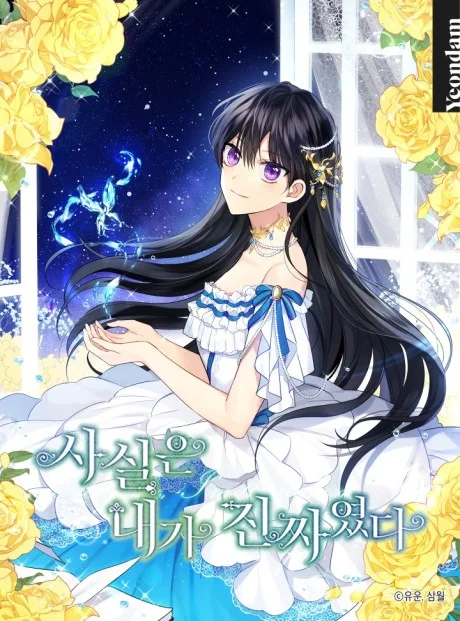 The original Korean cover, titled 사실은 내가 진짜였다. The creator credit at the bottom right confirms Yuwoon and Samwol directly on the official art.
Season Two: The Wider Threat, Chapters 41-90
Season 2 opens at chapter 41, "The Past Joseph," and the register shifts once the immediate household conflict from Season 1 has settled. The chapters through the 50s and 60s ("Elemental Crystal," "Intruder in the Basement," "Entrapment," "Suspicions") widen the plot past pure domestic politics, introducing the elemental-power and ceremony material that becomes load-bearing later.
Chapter 63 through 67, "Who Will Perform the Rite?" through "Fire," cover a ceremony arc that raises the stakes beyond what Season 1 established. From there, the series moves into a hunting-festival stretch (chapters 81-90: "The Trip to the Hunting Festival," "Day One of the Hunt," "The Fawn," culminating in chapter 88's "A Demonic Monster") that introduces the demon-world threat directly into the plot for the first time. This is a meaningful widening of scope. Season 1 was a household and court story; by the end of Season 2's first act, I Am the Real One is a story about a wider magical threat that happens to also be a household and court story.
Two chapters here are officially labeled side content: chapter 91, "Side Story 1," and chapter 92, "Side Story - Rowena," both following the hunting-festival arc. They're part of the numbered 160-chapter count, so skipping them doesn't lose you any of the main plot's mechanical setup, but they're worth knowing about in advance if a reader wants to prioritize main-plot momentum on a first pass.
For readers who want the wider list of completed royal-court isekai romance manhwa this series sits alongside, the best villainess manhwa of 2026 covers where I Am the Real One ranks against the rest of the category.
For a cleaner, tonally more consistent example of the same completed royal-court isekai format:
Who Made Me a Princess Review →
The Climax and Resolution: Chapters 91-150
From chapter 93 ("The Deal") onward, the demon-world material and the household identity conflict start converging. The back half of this stretch, chapters 100 through 134, deals with investigation and shard-hunting plot mechanics ("Cosette's Plan," "Ajayi's Eye," "Find the Shard," "The Demons' Meeting," "Where Is Cosette?"), building toward the confrontation the entire series has been setting up since chapter 1.
Chapter 135, "Keira versus Cosette" on the official episode list, is the direct confrontation between the two women at the center of the series' identity conflict. That's not a spoiler beyond what the chapter title itself already states, and it's useful to know as a chapter-number anchor if you want to track how close you are to the climax on a first read.
Plenty of villainess-isekai manhwa stage their equivalent confrontation well before the halfway point, once the identity conflict is established but before the reader's patience runs thin. I Am the Real One waits until chapter 135, well past its own season break. That's a structural choice worth noticing: the series treats the confrontation as an endpoint the political and magical plotlines have to earn, not a midpoint reveal to build a second act around. The chapters that follow, "Stand Up," "Two Spirits," "Time to Explain," "The Price," and "Keira's Elemental Powers," work through the immediate aftermath before the series widens back out to the family and political consequences: "Grand Duke Parvis Tells All," "A Redefined Relationship," "Peace Treaty."
Chapter 150, "The Goddess," is where the identity-conflict plot closes out. If you're reading for the revenge-and-identity hook that opens the series, this is functionally the ending. Two bonus chapters, "Special Episode 1: Being Alone Is Lonely" and "Special Episode 2: More Friends Than You Know," sit between chapter 150 and the chapter 151 restart, and they read as a deliberate breather before the tone shifts one more time.
The Epilogue: Chapters 151-160
This is the stretch the review describes as the series' "tonal shift from revenge thriller to healing family drama," and the chapter titles make the shift explicit: "Living in the Human World," "A Walk in the Garden," "Men Are Wolves," "Preparing to Propose," "Is He Avoiding Me?," "A Dinner Date," closing with chapter 160, "Our Way."
None of the identity-conflict tension from the first 150 chapters carries into this stretch. It's a distinct romance-and-domestic-life epilogue, not a continuation of the same plot engine. Readers who came to I Am the Real One purely for the regression-and-revenge hook may find the pivot jarring if they don't know it's coming; readers who want the full arc, including the aftermath of what the identity conflict cost Keira personally, will find this the payoff the rest of the series was building toward. Either way, going in with the expectation set correctly changes how the last ten chapters land.
Tips for Reading I Am the Real One
Don't judge the series by the chapter 12-30 stretch alone. It's genuinely the slowest part of the 160-chapter run, and the chapter titles from that section ("A Good Conversation," "Somewhere Fun") undersell how much the back half of Season 1 and all of Season 2 pick the pace back up.
Use the "End of Season One" marker at chapter 40 as your natural first stopping point. A 160-chapter binge in one sitting is a real time commitment; the platform itself has already built in a sensible place to pause.
If you only want the identity-conflict plot and not the romance epilogue, you can reasonably stop around chapter 150. "The Goddess" closes out the Keira/Cosette conflict cleanly. Chapters 151-160 are a genuinely separate story beat, so skipping them costs you the romance payoff but not the main plot's resolution.
Compare the pacing against The Remarried Empress if you've read both. That series keeps its political conflict front and center for its full 247-chapter run, while I Am the Real One deliberately downshifts into domestic romance once its identity conflict resolves. Knowing which structure you prefer going in helps set expectations for how the last quarter of this series will feel.
For readers who want the identity-conflict tension sustained further into a series, without the late pivot to a romance epilogue:
The Remarried Empress Review →
Who This Reading Guide Is For
This guide is for readers who've already decided to read I Am the Real One and want a real chapter map rather than vague "early" and "late" descriptions, especially through the chapter 12-30 stretch that the review already flags as a common drop-off point. It's also useful for anyone who stalled somewhere in Season 1 and wants to know how much further the slow patch runs before Season 2 opens things back up.
It's less useful if you haven't decided whether the series is worth reading in the first place. For that, the full review covers the rating, the art, and the specific pros and cons in more depth than a pacing-focused guide can.
Where to Read I Am the Real One
Advertisement
I Am the Real One is on Tapas, which carries the complete official English translation across all 160 chapters plus bonus content. The Korean original, 사실은 내가 진짜였다, is available on Kakaopage. No anime adaptation has been announced as of this guide's writing.
Related Reading
- I Am the Real One Review: the full 7.3/10 verdict on the premise, the art, and the case for and against the series
- Who Made Me a Princess Review: a cleaner, tonally more consistent completed royal-court isekai for comparison
- The Remarried Empress Review: a longer completed royal-court series that keeps its political conflict sustained rather than pivoting to romance late
- Best Villainess Manhwa of 2026: the wider genre list, including where this series ranks against the rest of the category
- Manhwa Like I Am the Real One: 4 Picks for the Wait: where to go for the closest structural match, sustained tension, the revenge payoff, or a romance-forward alternative
Frequently Asked Questions
How many chapters does I Am the Real One have?
160 numbered chapters, confirmed from the official Tapas episode list, plus 4 unnumbered bonus posts. The series is completed.
Does I Am the Real One have two seasons?
Yes. Tapas marks the split directly: chapter 40 is followed by an "End of Season One" entry, and chapter 41 opens Season 2.
Where should I start reading I Am the Real One?
Chapter 1, "Devoted Daughter." There's no prequel. The regression setup lands within the first six chapters.
Where does I Am the Real One get slow?
Roughly chapters 7 through 30, the court-life integration stretch between the regression setup and the season's later reveals.
What happens at the end of I Am the Real One?
The Keira/Cosette confrontation resolves around chapters 135-150. Chapters 151-160 are a separate epilogue focused on Keira's life and romance after the main conflict resolves.
Do I need to read anything before I Am the Real One?
No. It's Samwol's original story with art by Yuwoon, with no light novel or spinoff behind it.
Where can I read I Am the Real One?
Tapas carries the complete English translation. The Korean original is on Kakaopage.
References
- I Am the Real One on Tapas: official English platform, complete 160-chapter episode list with titles and season markers
- I Am the Real One on AniList: series metadata, staff credits, and publication status
Was this guide helpful?
About the author

Critical Theorist & Features Writer
Manhwa and webcomic critic with a background in literary analysis. Writing about narrative and genre since 2016. Specialises in genre history and story structure.
- Manhwa and webcomic critic since 2016
- Graduate background in comparative literature
- Published criticism covering Korean and Japanese comics
- Specializes in genre lineage and narrative structure


Disclaimer
This article is published for informational and entertainment purposes. It does not constitute professional financial, legal, or technical advice. Series availability, platform access, translation status, and chapter counts change. Verify critical details (pricing, regional availability, official translation status) with publishers and platforms. Affiliate links, where present, help support our editorial work and are labelled in our affiliate disclosure.
Comments
Loading comments…